
Most purchases in this dataset happened online.

What 412 purchase entries show about where runners buy shoes
Key finding
Online buying is the dominant purchase channel among runners logging shoe purchases in Run-It. We analyzed 412 logged running shoe purchases from the previous 6 months, where each entry included a purchase channel and a 1 to 10 satisfaction rating. 73% of purchases happened online and 27% happened in physical stores, with online purchases averaging 8.1 out of 10 for satisfaction compared with 7.6 out of 10 for in-store purchases. This does not prove online buying is always better, because channel choice is observational and satisfaction can reflect runner experience, return policies, sizing confidence, price, and available models. It does show that many runners arrive at online purchases with clearer model knowledge, broader inventory access, and stronger fit preferences. Run-It adds the missing layer by checking how Garmin or Stryd mechanics respond once the shoe is used over real runs after purchase. Before buying, runners can start with free online running shoe analysis to turn that run data into a shortlist.
How we collected this data
We pulled this data from the Run-It platform, shoe purchases and post-purchase satisfaction ratings logged by real users over the previous 6 months. The dataset includes 412 purchase entries. Each entry reflects a user-reported purchase channel (online or in-store) and a satisfaction score on a 1 to 10 scale, recorded at the time the shoe was added to their profile.
About 73% of shoes were bought online, versus 27% in physical stores. Shoes bought online were rated higher on average, approximately 8.1 out of 10, compared to 7.6 for in-store purchases. Below, we unpack the factors runners cited to explain this gap.
Why online shoe purchases score higher: research beats fitting rooms
The intuitive expectation is the opposite: trying a shoe on in a physical store should increase the chance you get it right. But runners in the community pointed to several reasons why that logic breaks down in practice.
Pre-purchase research is the biggest factor. Online buyers often arrive at the purchase decision having already watched dozens of YouTube reviews, read comparison articles, and considered their own run history. By the time they click buy, the decision is settled. In a store, that same runner is often met with a gait analysis that funnels them toward a stability shoe the store has in stock, even if that is not what they need.
Several runners put it plainly: the staff recommendation is shaped by what is available, not by what is optimal. And when a shoe underperforms after a few runs, the regret lands differently when you feel you were steered into it.
Stock, sizing, and selection: where physical stores fall short
Limited inventory is the second major factor. Physical stores carry a limited slice of the market. Runners with wide feet, narrow feet, or larger sizes consistently reported that local stores either did not stock what they needed at all, or only offered one stability option in their size. Online removes that constraint entirely.
Sizing inconsistency also came up as a real frustration. The same foot can need a different size depending on the brand, and sometimes depending on the model within a brand. Experienced runners have already mapped their own sizing patterns. Newer runners have not, which is one reason beginners still tend to prefer going in-store first, even if they end up buying online for repeat purchases once they know what they are looking for. Where to buy is the second question, though. If you have not settled the first one, start with which running shoes to buy.
Runner experience level predicts purchase channel
The more experienced the runner, the more likely they are to buy online and rate it highly. Experienced runners know their foot shape, their preferences, their trusted brands, and often the specific model version they want. They do not need a store employee to figure that out for them.
The store environment works best for first-time purchases of a brand or model the runner has never tried. Multiple runners described using a store to try on a shoe, confirm the fit, and then buying it online, sometimes from the brand directly, sometimes through a discount channel.
What this means for choosing running shoes
The 73% online figure reflects runners who have moved past the general-advice stage and are making decisions based on their own accumulated knowledge. The problem is that knowledge is still mostly external: reviews, specs, Reddit threads. It is rarely grounded in the runner's own biomechanical data.
Biomechanical running data, including ground contact time, vertical oscillation, and cadence patterns across different shoes, adds an objective layer that neither store fitting nor online reviews can provide. When you can compare how your body actually responds to two different shoes over real training runs, the purchase decision shifts from opinion-based to evidence-based.
That is the gap Run-It is designed to fill. Not by replacing the research process, but by adding a layer beneath it: what does your actual running data show across different shoes, different paces, and different effort levels? That question does not get answered by a treadmill gait analysis or a YouTube review. It gets answered by looking at what happens over real runs.
Sources and methodology
Source: first-party Run-It platform purchase logs from the previous 6 months. Inclusion rule: entries needed a running shoe purchase channel, either online or in-store, plus a 1 to 10 satisfaction rating.
Limitation: this is observational purchase feedback from Run-It users, not a randomized channel test. Satisfaction can be affected by runner experience, return policy, price, sizing knowledge, and the models available at the time of purchase.
FAQ
Where do runners buy running shoes?
In Run-It's dataset of 412 purchase entries from the previous 6 months, 73% of logged running shoe purchases happened online and 27% happened in physical stores.
Are runners happier with shoes bought online or in-store?
In this dataset, online purchases averaged 8.1 out of 10 for satisfaction, compared with 7.6 out of 10 for in-store purchases.
Why might online running shoe purchases score higher?
Experienced runners often buy online after doing more pre-purchase research, comparing more models, and learning their own fit preferences. Physical stores can still help with first-time fit checks, but local inventory and generic fitting advice can limit the recommendation.
Related Articles
What is most important in running shoes?
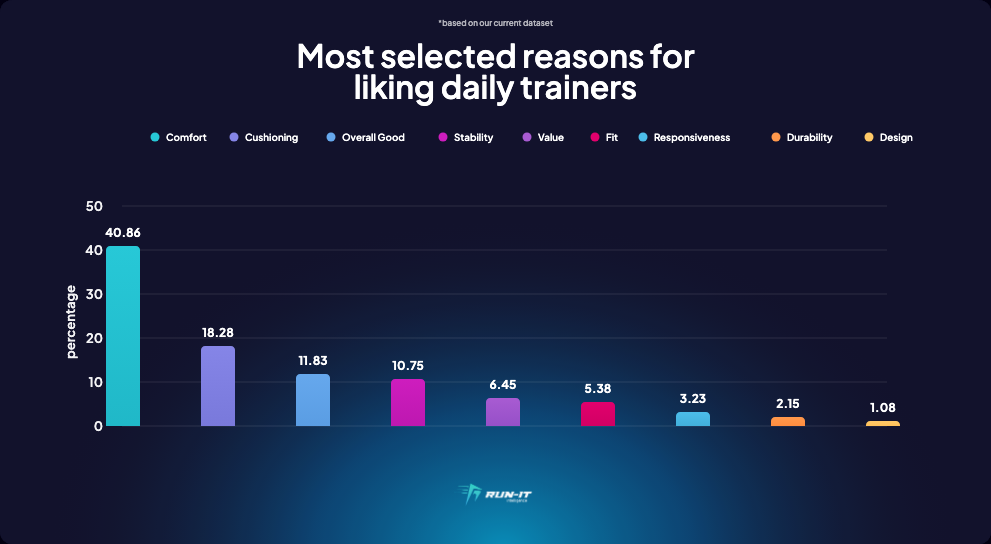
Run-It feedback shows comfort was the top selected reason runners liked daily trainers rated 7/10 or higher, at 40.86%, ahead of cushioning and stability.