
Key finding
The standard running shoe gait analysis still used in many stores is built around a simple idea: watch a runner for a few steps, classify pronation, then recommend a neutral, stability, or motion-control shoe. The problem is that research has never confirmed this as a reliable injury-prevention system for most runners, so pronation should be context rather than the whole prescription.
Run-It analyzes your Garmin and Stryd runs to recommend road running shoes and compare shoes you already own. Repeated runs add context about pace and fatigue; trying shoes helps you assess fit and comfort. Run-It does not measure pronation from running dynamics. See Run-It versus in-store gait analysis for a practical comparison of what each approach can tell you. For the decision itself, including whether you need a race shoe alongside your daily trainer, see which running shoes to buy.
What traditional running shoe analysis usually means
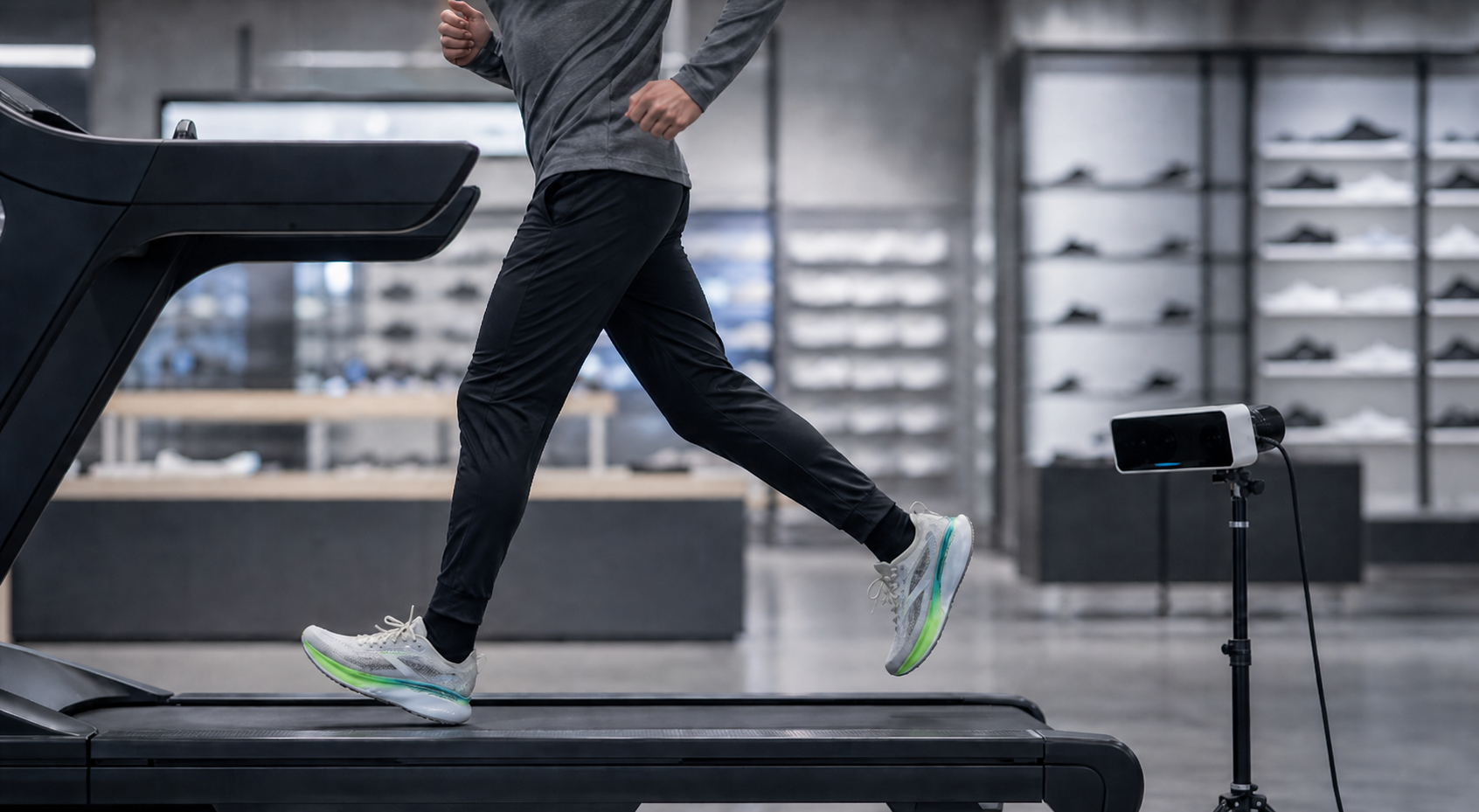
In most running stores, gait analysis means a short video of you running on a treadmill. The person fitting you watches the rearfoot and ankle, then decides whether your foot looks neutral, pronated, or supinated.
Some stores add a pressure plate, pressure scanner, static foot-shape scanner, or arch measurement. Those tools are not all the same. A pressure system is about load distribution: you run over a plate or mat, and the system turns that contact into a footprint, hot-spot map, pronation-style label, gait-line trace, or center-of-pressure line. A static 3D foot-shape scanner is different. It measures dimensions such as length, width, and volume, which can support sizing.
The issue starts when either output is treated as a full running-shoe prescription. For pressure systems, a systematic review of plantar-pressure studies in runners found no consistent injury-risk pattern. For static 3D foot-shape scanning, the value is narrower: it can measure foot dimensions more precisely than a footprint, but shoe fit still depends on the shoe last, upper volume, socks, swelling, orthotics, and preference. In a store, the pressure-map moment can be a polished demonstration of load distribution, and the shape scan can support sizing, but neither is a validated analysis of which shoe you should buy by itself.
Pronation belongs on the pressure-analysis side, not the sizing-scan side. It is the normal inward rolling and loading movement of the foot after contact with the ground. In many running stores, this is the thing being analyzed: does the runner look neutral, does the foot roll inward, or does the runner look like an overpronator? The retail shortcut is turning that normal variation into a verdict: neutral shoes for neutral runners, stability shoes for mild pronators, and motion-control shoes for runners believed to overpronate.
How that pronation verdict is made
Once pronation becomes the target, the next question is how it is judged. In most stores, that judgment is not built from your real training history. It comes from a short treadmill clip, a few meters of running inside the shop, or a brief pressure-system pass. That observation can then shape advice about pronation, stability shoes, cushioning, or injury risk, even though the test environment is not the same as your real running environment.
A store treadmill test can still be useful as a quick observation. The limitation is that it is usually a short run, often at a pace chosen for the test, inside a controlled space, with no hills, corners, uneven surface, weather, fatigue, or late-run mechanics. In other words, it may show how you move during that test, not how your foot loads across the runs where the shoe will actually be used.
Research does not say treadmill running is useless. It says the details matter. A 2020 Sports Medicine systematic review found treadmill and overground running are largely comparable for many measures, but footstrike-angle and other biomechanical differences still require caution when extrapolating treadmill data to overground running.
In plain language: yes, running on a treadmill can change parts of your form. Not everything changes, and not every runner changes in the same way, but enough can shift that a short in-store treadmill clip should not be treated as the full truth of how you run outside.
A separate systematic review found that some physiological, perceptual, and performance variables differ between treadmill and overground running, and that differences can depend on speed. That matters for store analysis because many tests are not done at your natural easy pace, your tempo pace, or your tired long-run pace. So the issue is not "treadmills are bad." The issue is using a brief treadmill run as a confident shoe prescription for the conditions where someone actually trains and races.
The gait-line promise
The running-shoe gait line means the pressure trace created during a step. In retail pressure-plate or pressure-insole systems, it is the line drawn through pressure data as the runner loads and leaves the ground. It is usually presented as foot roll-off: where pressure starts, how it moves through mid-stance, and how the runner pushes off.
So yes, the retail gait line is closely related to the biomechanical center-of-pressure path: it is a pressure-derived trace of how load travels under the foot or through the shoe during stance. A Gait & Posture study describes the gait line as the projection of the center of pressure on the support surface. That makes it a real measurement of the test, not just a visual trick.
Where the evidence gets thin is the prescription step. A gait line can describe roll-off and compare shoes during a short test. It can show whether pressure travels more medially or laterally, whether the transition looks abrupt or smooth, and whether one shoe changes the pressure path compared with another. That is useful information. There is no strong direct evidence that a retail gait-line analysis tells you which running shoe to buy, or that achieving a “correct” gait line prevents injury. Useful information is not the same as a validated rule that says: align the line this way, and this is the best shoe.
The research base is still exploratory. The Gait & Posture work treated center-of-pressure trajectory as a potential measure of foot function, not as a retail shoe-matching algorithm. Footwear researchers have tried to quantify shoe "ride" using center-of-pressure progression during running, including a 2018 Footwear Science paper. But a later running-shoe and speed study tested only five participants and found that shoe type and running speed changed the signal, with no simple answer for how shoes influenced the measure. That is why the gait line should be treated as one shoe-feel and roll-off clue, not strong evidence that every runner has an ideal pressure path or that matching that path predicts the best shoe.
Why pronation and arch became the shortcuts
A 2022 Frontiers review describes pronation control as one of the earliest and best-known running-footwear paradigms, emerging in the late 1970s when recreational running was growing and injury rates were a major concern. The logic felt reasonable at the time: if excessive foot motion was assumed to create stress higher up the chain, then a shoe could be designed to control that motion.
Pronation and arch type were also easy to see, easy to explain, and easy to sell. If the ankle rolled inward, the shoe could be framed as the correction. If the pressure footprint looked flat or high-arched, the shoe could be framed as the matching category. That made running shoe advice feel scientific, even when the recommendation was based on a few treadmill steps, a pressure-plate pass, a static foot-shape scan, or a visual judgment.
That matters because injury prevention is often the selling point. Running stores can make pronation analysis feel like protection: find your foot type, correct it with the right shoe, and reduce your injury risk.
For most runners, that promise is mostly not true. A classic 2009 review in the British Journal of Sports Medicine looked for evidence that cushioned, pronation-control shoes tailored to foot type improved outcomes for distance runners. It found no original research meeting those criteria and concluded that this prescription approach was not evidence-based.
What the research says about foot-type matching and injury
The strongest summary is the 2022 Cochrane review on running shoes for preventing lower-limb running injuries in adults. It included 12 trials with 11,240 participants. For the specific question of prescribing shoes based on static foot posture in military-recruit trials, the review found that this probably makes little or no difference to lower-limb running injuries. That evidence is relevant to pronation-control marketing because plantar shape and arch height were often used as retail proxies for pronation, but it is not the same as directly measuring dynamic pronation.
Large trials by Knapik and colleagues tested that proxy directly. In one basic-training study, selecting running shoes from plantar shape did not reduce injury risk. A separate Marine Corps randomized trial assigned motion-control, stability, or cushioned shoes based on low, medium, or high arch-like plantar shapes. Injury risk was still similar between the experimental and control groups.
Click a bar to inspect the evidence.
Participants across 12 trials in the 2022 Cochrane review on running shoes and injury prevention.
Rate ratio in military-recruit trials when shoes were prescribed by static foot posture or plantar shape versus not prescribed by posture.
Marine Corps hazard ratios for men and women when shoes were assigned from arch-like plantar shape.
What the research says about pronation and injury
The direct pronation-injury link itself is also weaker than many runners are told. In a 927-runner prospective cohort published in the British Journal of Sports Medicine, novice runners all used neutral shoes for one year. Moderate pronation was not associated with increased injury risk. The study classified 122 of 1,854 feet as pronated and 18 as highly pronated, about 6.6% and 1.0% of measured feet respectively.
That gives the article its central line: broad support is weak for both static foot-shape matching and correcting moderate pronation. Plantar shape is a static proxy, not pronation itself. Moderate pronation is a dynamic movement, but it still has not consistently shown the injury risk that traditional shoe advice assumes.
The narrow case where pronation can matter
Pronation is not irrelevant. In one randomized controlled trial, Malisoux and colleagues followed 372 recreational runners for six months, and the clearest motion-control benefit appeared in the 94 runners classified in the pronated-foot stratum, about 25.3% of the sample. A later secondary analysis found lower risk for pronation-related pathologies, but not for all running-related injuries. The point is narrower: pronation-based support may help a specific subgroup, especially toward heavier overpronation, but it should not be the default shoe-matching logic for everyone.
How many runners does that leave?
The more defensible way to write this is as a range, not as one universal prevalence estimate. In the Nielsen novice-runner cohort, 7.5% of measured feet were pronated or highly pronated, and the highly pronated category alone was 1.0%. That is probably too strict to use as the only commercial-shoe benchmark. A smaller female-runner trial by Ryan and colleagues classified 12 of 81 runners as highly pronated, about 14.8%. Malisoux's broader pronated-foot stratum was 25.3%. So a practical reading is that strong overpronation is still a minority signal, roughly around the mid-teens in a broader runner sample, while broader pronated categories can reach about one-quarter depending on the threshold.
That leaves at least about 70% (!) of runners outside the group that current pronation-led gait analysis is best suited for. For those runners, a store pronation label, pressure-map label, or foot-shape category may be an observation, but it is too blunt to carry the whole shoe recommendation.
Click a bar to inspect the threshold logic.
What traditional analysis misses
The deeper problem is that traditional analysis often asks the wrong question. It looks for a category: neutral, pronated, supinated, low arch, high arch. But the useful shoe question is broader: what demand does your running place on the shoe?
A shoe is not only an anti-pronation device. It is foam, geometry, stack height, rocker shape, width, stiffness, outsole, upper lockdown, size, and ride feel. Your cadence, ground contact time, vertical oscillation, stride length, pace range, fatigue pattern, and asymmetry all change how that shoe behaves under you.
Fatigue is a good example. A 2021 systematic review on running-induced acute fatigue found that fatigue can affect running biomechanics, including contact time and other lower-limb measures. A short treadmill clip at the start of a fitting does not show how you load the shoe after 40 minutes, during intervals, or near the end of a long run. It also does not show whether your loading pattern stays stable or changes as pace and fatigue change. Running a few meters up and down a running store has the same problem.
How Run-It analyzes shoes differently
For a subset of pronated runners, especially at the more extreme end, motion-control information can sometimes be useful. For everyone else, traditional pronation analysis often has no meaningful next step.
That does not make existing analyses useless; it shows how much room there still is to improve. The research in this article suggests that broad labels like pronation, arch type, or a pressure-map line are too general to carry the whole shoe recommendation. Most shoe analysis still happens in controlled snapshots, while runners actually choose shoes for changing pace, fatigue, surfaces, and weeks of real use. With modern Garmin metrics, Stryd pods, artificial intelligence, and better runner feedback loops, the opportunity is a paradigm shift: move from generalized categories to detailed real-world shoe matching.
Run-It treats loading as the stronger signal: how long you stay on the ground, how much vertical movement you carry, how stride length changes with pace, and whether those mechanics drift when fatigue arrives. Pronation can still matter, but the recommendation should come from real running patterns, not from labeling one ankle angle in a store clip.
This is why we use the Loading Pattern Index, or LPI, inside our analysis. We will go deeper on LPI in a separate article, but the idea is this: the force you put through the shoe applied by your loading pattern, and how that force interacts with the midsole and rebound, can tell us more about the type of shoe you should buy than any pronation label ever will.
Run-It analyzes Garmin and Stryd data across recent synced training, including easy runs, long runs, intervals, races, different paces, and late-run mechanics. The second layer is feedback: runner opinions, shoe ratings, sizes, fit notes, and real shoe-use signals. That connects two things a store snapshot usually separates: how runners move, and how shoes actually feel after use.
Methodology and limitations
This article uses peer-reviewed research and systematic reviews to discuss retail gait analysis, pressure-map and gait-line measurements, static 3D foot-shape scanning for sizing, and pronation-based shoe selection. It is not medical advice and does not diagnose injuries, foot conditions, or clinical gait disorders.
The 6.6% and 1.0% Nielsen figures come from one novice-runner cohort using Foot Posture Index categories by foot, not from a universal population estimate. Other runner samples can classify many more runners as pronated when they use participant-level grouping, post-run screening, or broader pronation thresholds. The 70%+ statement is an inference from the broadest pronated stratum discussed here, not a pooled prevalence estimate.
Run-It does not claim to have perfect running shoe analysis or to prevent injuries. Our goal is to improve shoe matching by combining real running dynamics, shoe data, and runner feedback.
FAQ
Is running shoe gait analysis accurate?
It can observe how you move in that moment, but most retail gait analysis is too short and too narrow to predict the best shoe for your real training. It usually misses pace variation, fatigue, outdoor surfaces, and long-term shoe interaction.
Should overpronators always buy stability shoes?
No. Pronation is normal, and moderate pronation has not consistently shown higher injury risk. Some strongly pronated runners may benefit from motion-control features, but that is a narrower case than traditional shoe advice suggests.
What does Run-It look at instead of a pronation label?
Run-It looks at the demand your running places on the shoe: cadence, ground contact time, vertical oscillation, stride length, pace range, and fatigue drift. Those signals help match foam, geometry, stability, and ride feel to how you actually run.
What is the main Run-It insight from this article?
The main insight is that shoe choice should not start and end with foot category. Pronation can matter for a narrower subgroup, but most runners need a model that connects real loading patterns with shoe behavior and runner feedback.
Why does Run-It use Garmin and Stryd data?
Garmin and Stryd data show how you run in real sessions. That allows Run-It to analyze patterns like cadence, ground contact time, vertical oscillation, stride length, pace, and fatigue drift across actual training rather than a few treadmill steps.
Sources
- Relph et al., Cochrane Database of Systematic Reviews, 2022
- Richards, Magin, and Callister, British Journal of Sports Medicine, 2009
- Knapik et al., Journal of Strength and Conditioning Research, 2009
- Knapik et al., American Journal of Sports Medicine, 2010
- Mann et al., Gait & Posture, 2016
- Xiong et al., Journal of Foot and Ankle Research, 2014
- Menz et al., Journal of Foot and Ankle Research, 2014
- De Cock et al., Gait & Posture, 2008
- Lam et al., Footwear Science, 2018
- Mally, Hofstatter, and Eckelt, Proceedings, 2020
- Redmond, Crane, and Menz, Journal of Foot and Ankle Research, 2008
- Nielsen et al., British Journal of Sports Medicine, 2014
- Ryan et al., British Journal of Sports Medicine, 2011
- Malisoux et al., British Journal of Sports Medicine, 2016
- Willems et al., Journal of Orthopaedic and Sports Physical Therapy, 2021
- Van Hooren et al., Sports Medicine, 2020
- Miller et al., Sports Medicine, 2019
- Apte et al., Frontiers in Physiology, 2021
- Nigg et al., British Journal of Sports Medicine, 2015
Find the shoe signal in your real runs
Run-It uses Garmin and Stryd data to match shoes from loading, fatigue drift, pace range, and runner feedback, not from a single pronation label.
Open shoe analysis