

Quick answer
Loading Pattern Index (LPI) is Run-It's 0-100 view of pace-aware loading context from real running data across repeated sessions. It uses Garmin or Stryd signals such as pace, cadence, ground contact time, vertical movement, stride behavior, and fatigue context to ask a practical shoe question: is this runner loading the shoe in a range where the platform can feel comfortable, responsive, and controlled? LPI is not Strike Index, Dynamic Strike Index, Minimalist Index, a pressure-map score, or outsole wear-pattern analysis. A higher LPI is not automatically bad, and a lower LPI is not automatically better. The score is not a diagnosis, injury prediction, or universal performance grade. It means Run-It should compare similar, stable running windows and then judge the shoe beside comfort, rebound, stability, run purpose, and shoe history, keeping recommendations tied to how the runner actually moves instead of only to store categories such as neutral, stability, cushion, tempo, or race day in real training.
What LPI measures
Running shoes are usually sold through categories: neutral, stability, cushion, tempo, race day. Those labels are useful, but they do not explain how your own body loads the shoe. Two runners can wear the same daily trainer at the same pace and still show different impact loading, ground contact, vertical movement, and fatigue drift. That is why a loading-pattern category can be more useful than a store category: it starts with the runner's mechanics and then asks which shoe profile can make those mechanics feel comfortable and controlled.
Run-It uses LPI to make that difference visible. The score is a product-facing loading-pattern signal: it looks at how the run behaves at a given pace instead of treating shoe choice as a static label. In plain language, it is about the context of the load, not simply how heavy a runner is or how soft a shoe feels.
Garmin and Stryd analyses give Run-It useful running-dynamics context: speed, step rhythm, contact timing, vertical movement, stride behavior, and related watch or pod signals. Public device documentation explains these kinds of running-form measures in plain terms. Run-It turns the relevant context into one runner-facing LPI value so the shoe discussion stays practical and easier to compare across runs.
Keeps easy runs, workouts, and race efforts from being treated as the same situation.
Adds information about how the runner is moving, not just how fast they are moving.
Keeps the recommendation tied to real movement patterns rather than one isolated number.
Where LPI came from
Run-It started with shoe testing, not with a dashboard metric. Runners tested shoes, then answered structured questions: did they like the shoe, how did it fit, did it feel comfortable, did it respond well, and would they actually keep using it? That feedback loop made one pattern hard to ignore: comfort was the practical anchor.
In Run-It's product feedback work, a shoe could survive an imperfect fit note or a response note if the comfort story still made sense. When comfort fell, the whole shoe score usually became hard to rescue. That pattern created the product question behind LPI: how can Run-It connect a runner's loading style with the way a shoe actually feels under them?
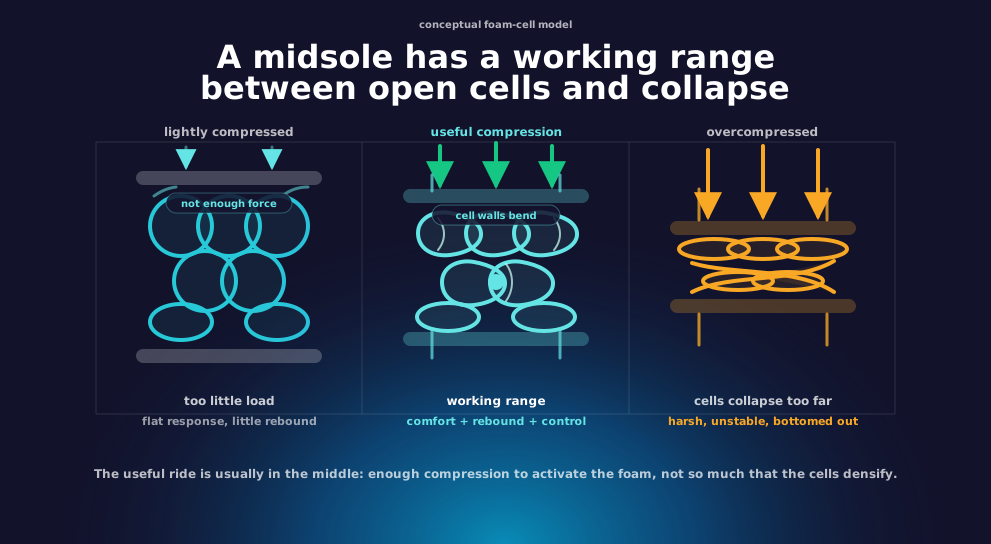
That is why LPI is not a soft-versus-firm shoe label. Run-It uses the shoe load window as a working model for how stack depth, foam compliance, rocker, plate or torsional stiffness, sidewall support, platform width, and outsole geometry may shape the ride. Too little load can make a shoe feel dull or disconnected. Too much load can push the shoe toward a harsher, bottomed-out feel. In this model, the useful target is the middle: enough compression to get comfort and rebound, not so much that the shoe stops feeling controlled.
Why comfort is the anchor
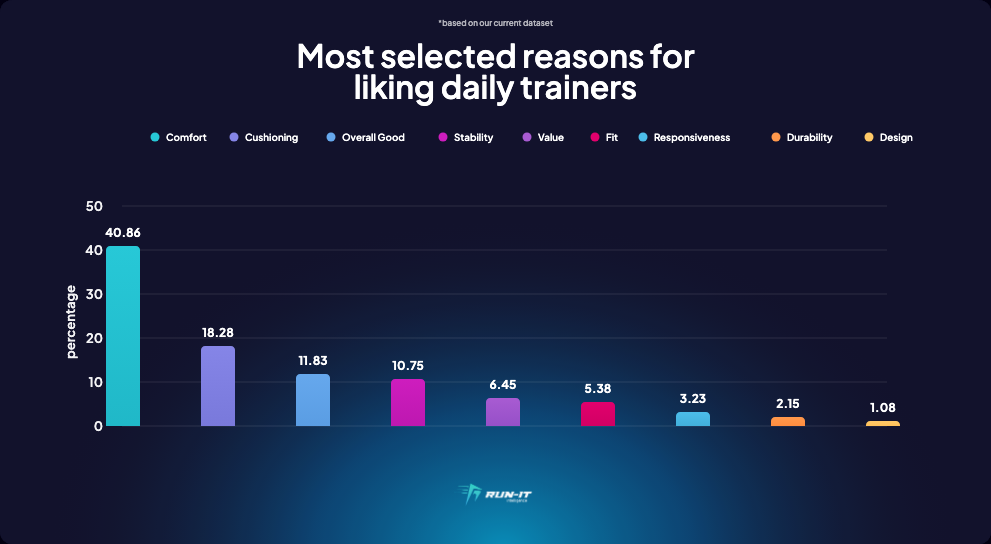
This connects directly to Run-It's earlier article, Why runners like daily trainers: comfort comes first. In that article, Run-It looked at daily-trainer feedback and found that runners selected comfort far more often than any other reason when they liked a daily trainer. The exact relationship between comfort and Run-It's overall shoe score deserves its own aggregate write-up later, but the product lesson is already clear: when comfort collapses, the rest of the shoe story usually stops mattering.
That does not mean comfort is vague or unscientific. Footwear research often discusses the "comfort filter" and preferred movement path: runners tend to prefer shoes that feel comfortable and work with their natural movement. A 2015 British Journal of Sports Medicine paper proposed comfort and preferred movement path as useful footwear paradigms, and a later Frontiers review describes comfort as an important, still-developing lens for shoe selection.
The careful version is this: comfort is not a magic injury-prevention rule, and it is not the only thing Run-It looks at. It is the best practical anchor for shoe matching because it is where foam mechanics, stability, fit, rebound, fatigue, and runner preference all show up at once. LPI exists to make that anchor less random by explaining why one runner may land closer to a shoe's useful range and another runner may not.
What Run-It sees in the data
The LPI hypothesis starts with the pattern, not with foam theory. In Run-It's shoe-testing feedback and matching work, the same broad story keeps appearing: runners do not simply reward the shoe with the most cushion or the most response. They reward the shoe that feels comfortable, responsive, and controlled for the way they load it.
Run-It currently reads that pattern as different personal sweet spots. Runner A may feel best when the shoe compresses earlier and returns smoothly. Runner B may sit nearer the middle of the proposed working range. Runner C may need more shoe-side resistance before the platform feels stable and alive. The same shoe can therefore feel dull to one runner, ideal to another, and harsh to a third.
The useful takeaway is simple: shoe choice works better when Run-It can compare stable, similar running contexts and then reason about how the shoe may behave under that runner. This article stays at the runner level: what LPI helps explain, why comfort matters, and why different shoes work for different loading patterns.
The hypothesis in one sentence
LPI helps Run-It compare runner-side loading with a shoe-side working-range hypothesis, so recommendations can account for comfort, rebound, and stability instead of relying on a static shoe category.
How to read this model
The shoe-load-window idea is Run-It's current interpretation of patterns seen in shoe-testing feedback and matching data. It is not validated biomechanical science, and it should not be read as proof that every shoe has a precisely measurable window for every runner. Foam mechanics gives a plausible reason this pattern could happen; Run-It feedback gives the product signal that makes the idea useful today. As more aggregate data and lab work become available, this explanation may be refined or changed.
LPI and the shoe load window
LPI describes the runner side of the equation. The shoe load window is the shoe-side model Run-It uses to reason about the match. A deep compliant platform, a structured daily trainer, and a tempo shoe can all be good shoes, but they do not ask for the same loading pattern. Their stack depth, geometry, rebound timing, platform width, rocker, and stiffness may influence where the ride starts to feel alive and where it starts to lose control.
If a runner appears to sit above that window in this model, the shoe can feel harsh because the platform may be driven past its useful compression range. If a runner appears to sit below that window, a deep or highly compliant shoe can feel like a sandbag: slow to settle, slow to return, and unstable because the foot keeps moving before the platform gives structure back. That is why Run-It treats comfort as more than plush feel. Run-It's current interpretation is that the best feeling often comes from alignment between the runner's loading pattern and the shoe's practical working range.
This is personal. Two runners can have the same body weight and buy the same shoe, but one may sit closer to the shoe's useful range while the other sits outside it because of cadence, strike pattern, ground contact, vertical movement, fatigue drift, or run purpose. LPI helps Run-It make that possible mismatch visible before it becomes a vague "this shoe feels dead" or "this shoe feels unstable" complaint. In the chart below, Runner A, B, and C show three simplified loading contexts.

The foam explanation
Once the feedback pattern is clear, foam mechanics gives a useful possible explanation. The model is not "more cushion is always better." It is that Run-It currently treats each shoe as having a practical working range, and the midsole is one of the biggest reasons each runner-shoe pairing may create a different amount of strain inside that range.
Foam does not behave like a simple on/off cushion. Compression testing of closed-cell EVA foam describes three broad regions: an initial elastic region, a plateau region where the cells deform and absorb energy, and a densification region where stress rises sharply after the cells have collapsed too far. The same work describes an optimal energy-absorption point before densification. Run-It uses that as a useful mental model for the shoe: there may be a practical range where the shoe feels most controlled and alive.

Before simplifying that idea, it helps to look at real foam cells. Open-access microscopy of EVA, TPU, and PEBA polymer foams shows why the drawing below should stay conceptual: cell size, wall thickness, openings, and collapse patterns change by chemistry and processing. The shared point is that these foams are cellular structures, not uniform blocks.
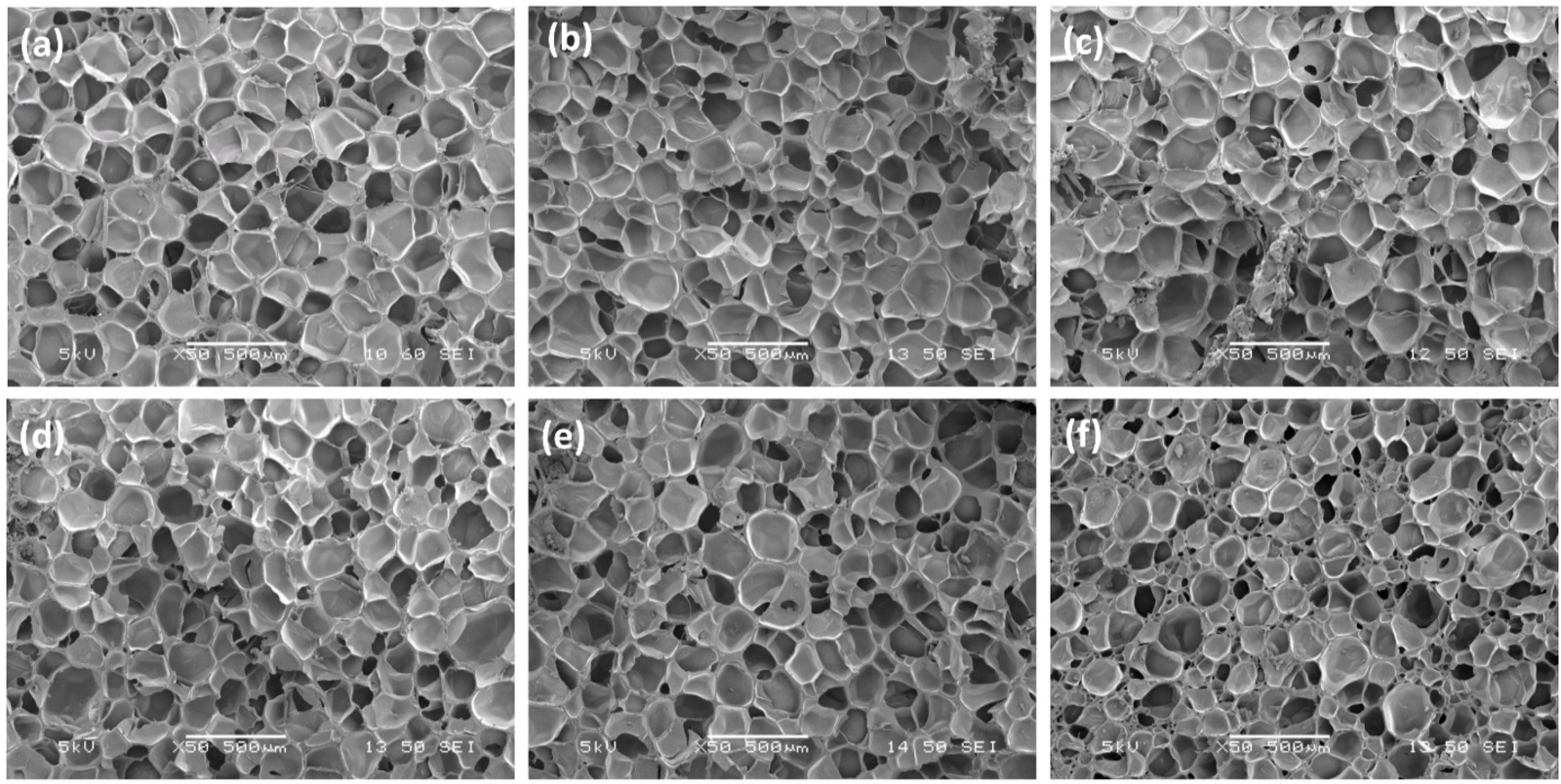 EVA foam cells from a sports-footwear foam study.
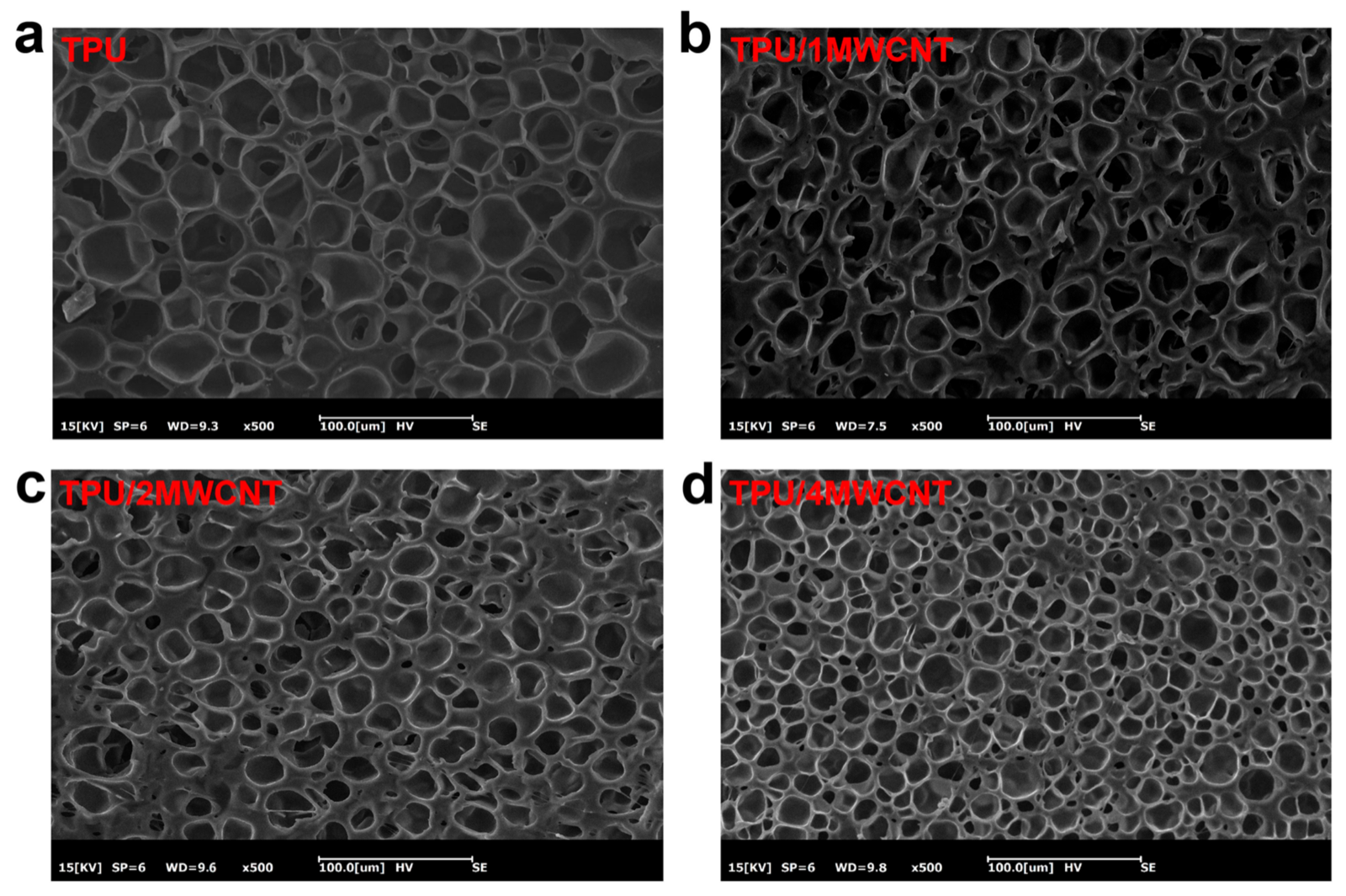 TPU foam cells from a high-resilience polymer foam study.
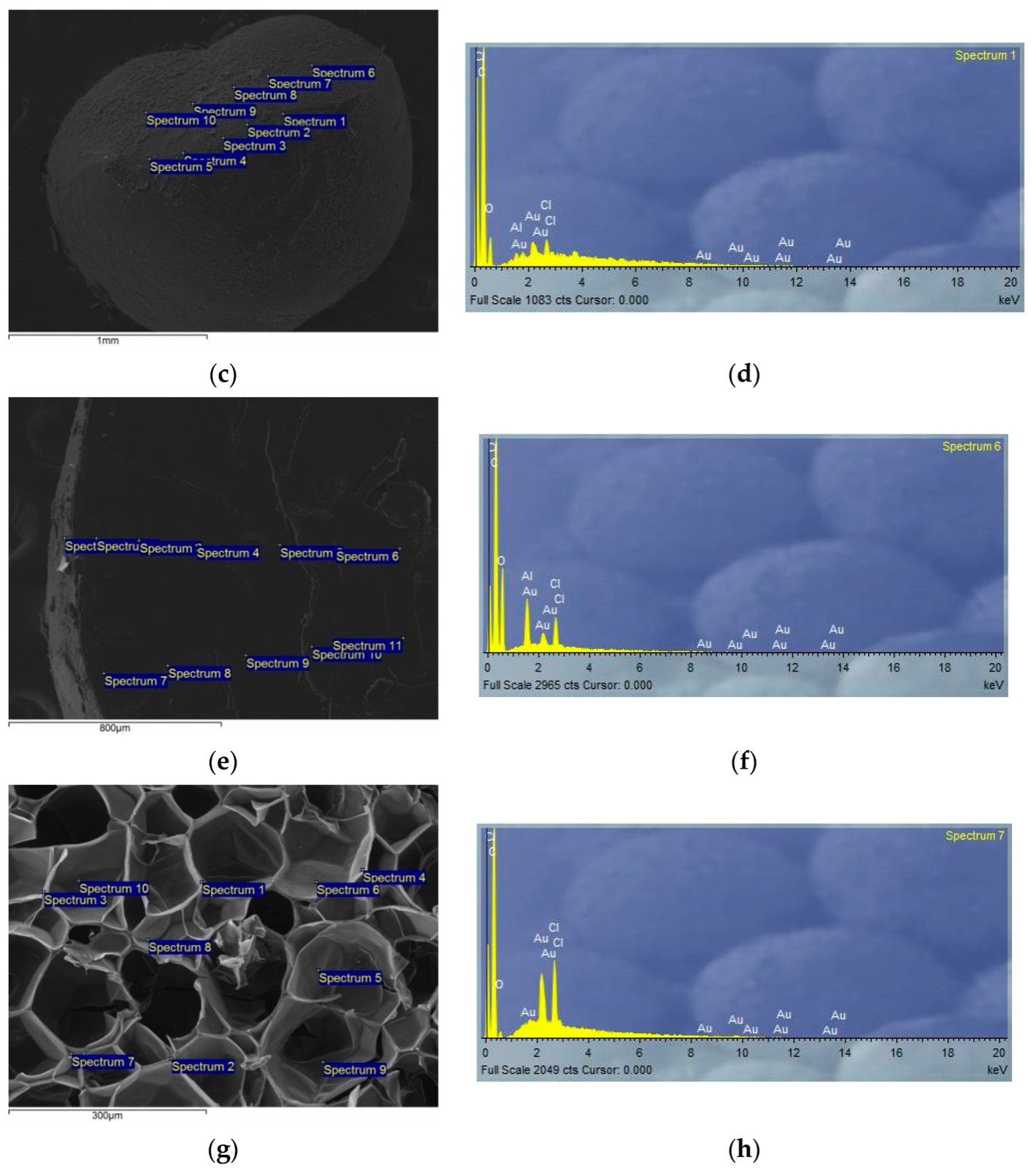 PEBA polymer foam cell reference.

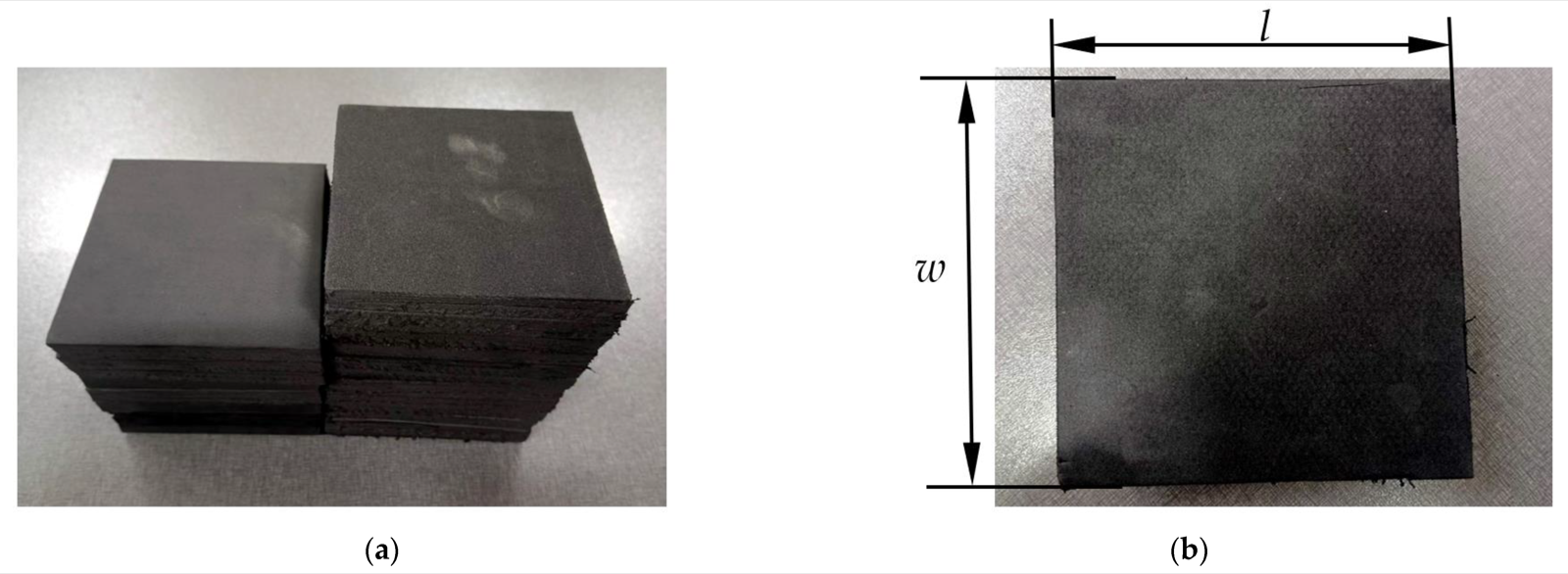 EVA foam specimens and sample dimensions used in compression testing.
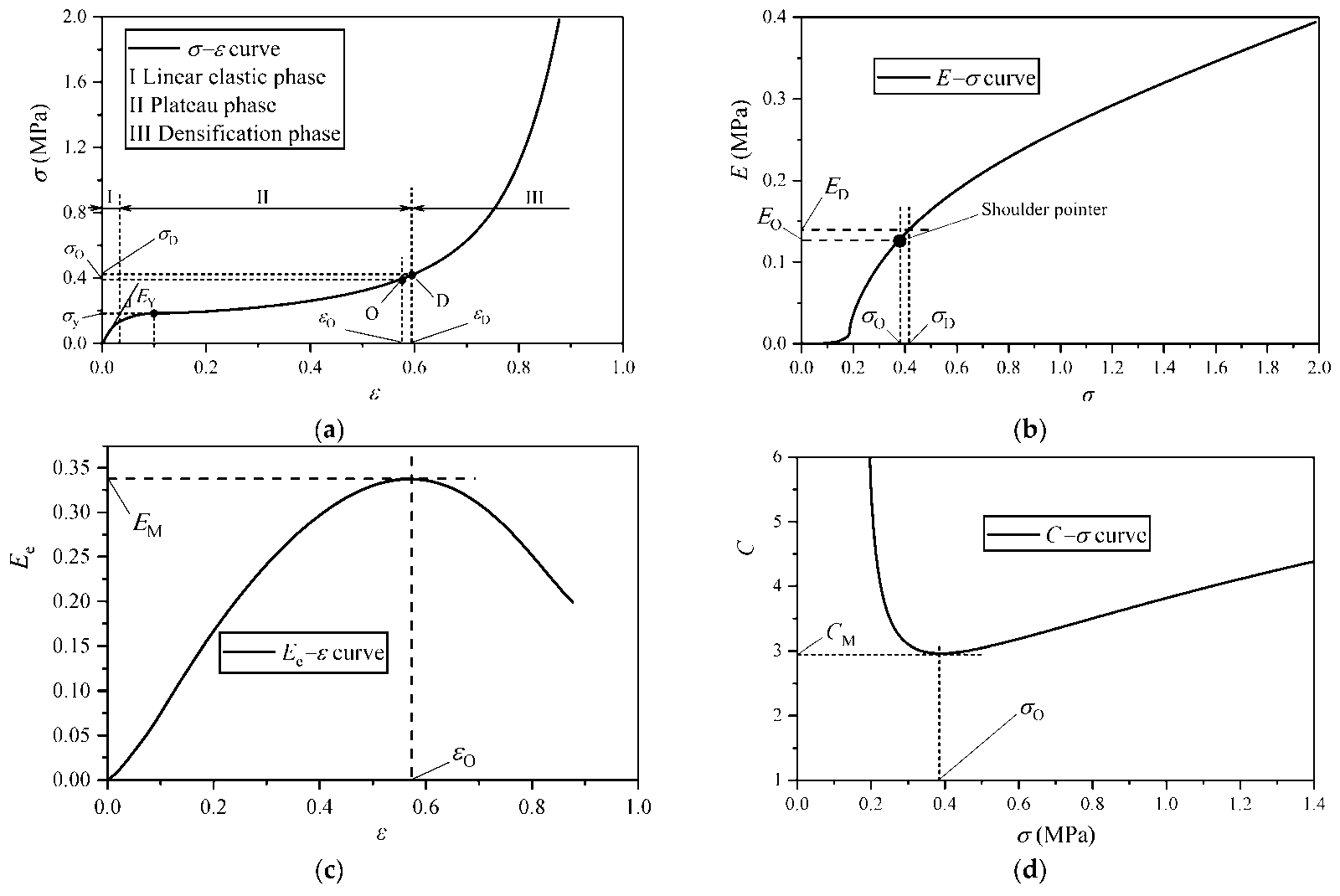 Response curves showing elastic, plateau, and densification regions.
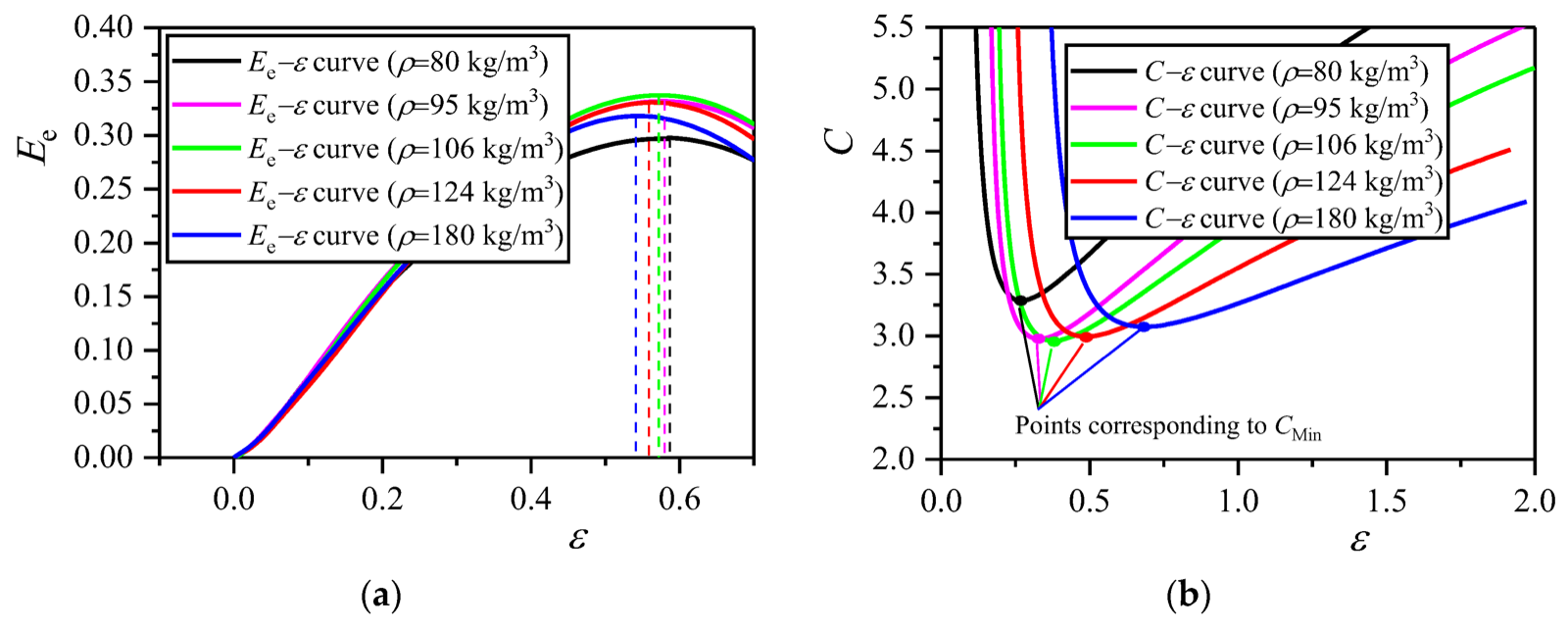 Energy absorption efficiency and cushioning coefficient curves.
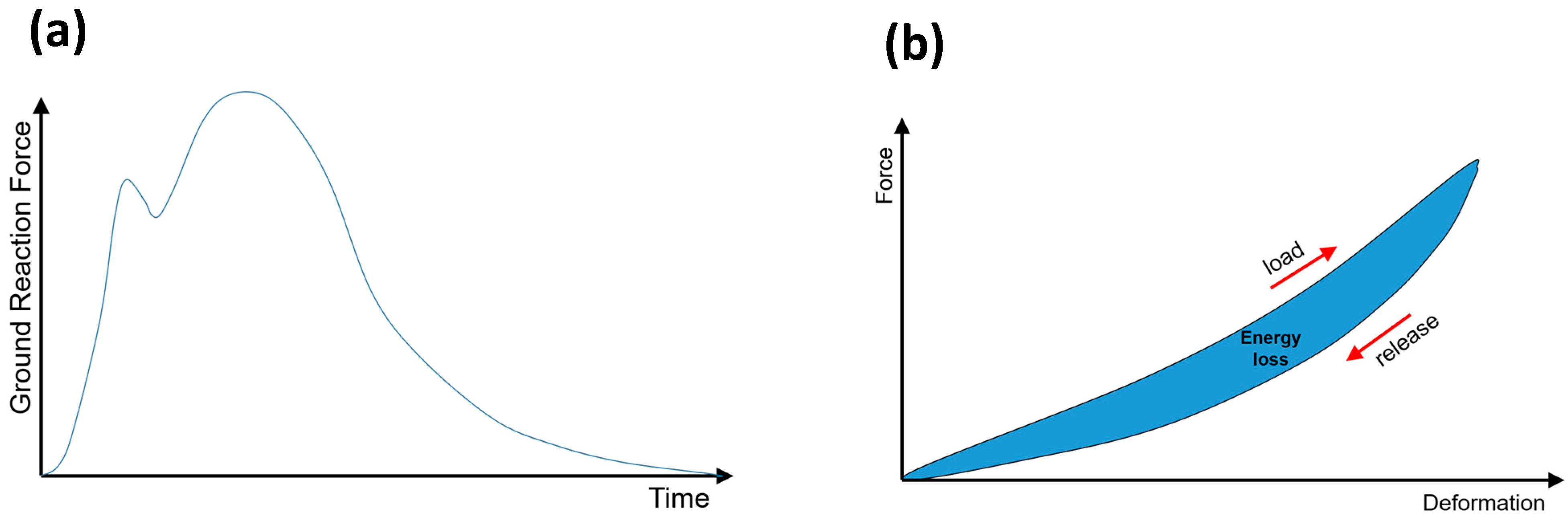 Running-step ground reaction force and the shoe-midsole hysteresis loop.
The cushioning-efficiency source figure is important because it is specifically an Ee-strain curve. In the EVA compression paper, energy absorption efficiency rises with compression strain, reaches a peak at the optimal strain, and then falls as the foam is driven toward densification. That is the curve Run-It should compare with the sweet-spot idea: not shoe resistance on the x-axis, but the estimated strain a runner-shoe pairing creates inside the midsole.
The hysteresis loop is the visual way to understand it, and it should be read from real force-deformation references rather than an invented curve. In the source figure above, the shoe is loaded and then released; the loop area is the energy lost during the cycle. RTINGS uses the same force-displacement idea in running-shoe compression testing, and a 2024 Footwear Science review shows a real midsole-foam compression test with displacement, force, and force-displacement panels. The practical translation is simple: cushioning comes from energy absorbed on the loading phase, and energy return depends on how much of the cycle is not lost.
This is also why comfort and rebound are linked, but not identical. A running-shoe cushioning perception study found that lower impact peak only explained some comfort comparisons; response, energy rebound, and perceived stability also influenced what runners liked. Another Scientific Reports study showed that adding maximal cushioning did not automatically reduce loading in every running condition. The practical point for Run-It is simple: the best shoe is not always the one with the most give. It is the shoe whose construction works well with the runner's loading pattern.

Why pace adjustment matters
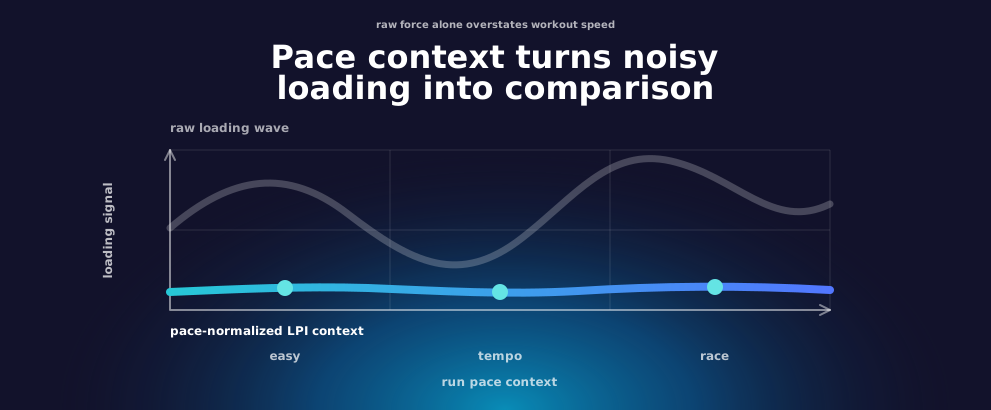
A hard interval and an easy recovery jog should not be judged on the same raw loading scale. Faster running usually changes rhythm, contact timing, stride behavior, and impact timing. If a score ignores pace context, it can make normal workout mechanics look like a problem.
Run-It accounts for speed context before presenting the loading-pattern signal as LPI. The final value is shown on a 0-100 range. The user-facing idea is simple: compare loading patterns in comparable contexts, then be stricter about which runs are clean enough to use as a direct baseline.
Why clean comparison windows matter
Run-It is most confident when LPI comes from a stable, comparable running window. In current product work, steady moderate efforts often give the cleanest direct baseline. Not because one public pace range works for every runner, but because the athlete is usually clearly running, with a readable movement pattern, without interval mechanics or race effort dominating the signal.
Very fast efforts can become less comparable. The runner may be changing mechanics because the effort is hard, the sample may include fewer stable seconds, and the relationship between speed and loading can become less linear. Very slow efforts can also weaken the signal: stride differences may be small, run-walk mechanics can blur the pattern, and watch or pod measurement error can take up more of the difference Run-It is trying to read.
That is why the effort needs to be stable, not merely close to a target range. Run-It wants a clean snapshot of running form: flat terrain when possible, steady effort, enough samples, and consistent signals. Runs outside the clean comparison window are still useful for context, especially when looking at fatigue, racing, or another specific purpose, but direct LPI summaries are treated more cautiously and should not be read like the same baseline signal.
Quick answer: why does LPI use a fresh window?
Run-It prefers fresh-window LPI because a stable early segment is usually a cleaner baseline than a whole-run average. The app looks for a settled, comparable part of the run where the runner is no longer just starting, the effort is steady, and the terrain and signals are clean enough to trust. This creates a repeatable comparison instead of mixing warm-up, hills, intervals, and late-run fatigue into one number.
Quick answer: what does a high LPI mean?
A higher LPI usually points to a higher pace-aware loading context. It does not automatically mean the runner is injured, inefficient, or in the wrong shoe. It means Run-It should be more careful about the shoe's load window: cushioning efficiency, rebound timing, platform stability, fatigue response, and repeated-run consistency before calling a shoe a strong match.
Where overpronation fits
Pronation is normal, and Run-It does not reduce the whole shoe recommendation to one rearfoot label. Our gait-analysis article explains why broad pronation-based shoe prescription is weak for most runners. A large prospective cohort by Nielsen and colleagues found that moderate pronation was not associated with increased injury risk in novice runners wearing neutral shoes, and the authors called out the need for more work on highly pronated feet.
The narrower case still matters. In a randomized trial, Malisoux and colleagues found that motion-control shoes lowered overall injury risk mainly in runners classified as pronated, while neutral and supinated groups did not show the same benefit. A later secondary analysis by Willems and colleagues found lower risk for pronation-related pathologies in motion-control shoes, but not for every injury type.
That is how LPI should be read. A heel-heavy or medially unstable pattern with higher loading does not mean "correct the runner at all costs." It means Run-It should avoid a shoe that is too compliant for that runner's load and should often favor a more structured, stable shoe load window. When the foam, geometry, and platform are supportive enough for the runner's load, the shoe can give stability back instead of letting the foot keep collapsing through the platform. The visible overpronation may then calm down because the shoe is no longer amplifying the instability. That stability is the practical outcome that matters. This is the difference between a data-driven shoe-matching approach and a sales shortcut: pronation, gait lines, and store categories are observations, but the better question is whether real running mechanics appear to land inside the shoe's comfort-producing working range.
How Run-It uses LPI for shoe decisions
Run-It looks at LPI beside other running-dynamics signals, run type, shoe history, and fatigue drift. The product can also compare cleaner early-run context with later-run context when enough data is available, which helps separate a runner's normal pattern from a late-run change.
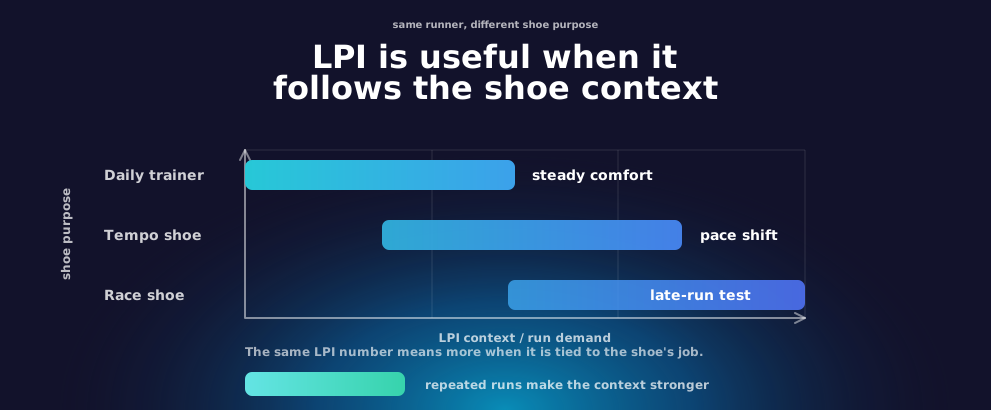
That matters for shoes because the question is not just "what is your average impact?" It is "what kind of shoe still works when your mechanics change?" A daily trainer may feel fine on fresh easy runs but become clumsy after long-run fatigue. A race shoe may feel fast at threshold pace but too aggressive for recovery mileage. LPI helps Run-It keep that context attached to the recommendation.
In the app, LPI also supports shoe rotation work. When Run-It has repeated runs for a shoe, it can compare the runner's loading and fatigue signals across shoes and purposes instead of forcing one generic category onto every run.
Run-It methodology note
This article is based on Run-It's product implementation, not a first-party population dataset. In the current product, LPI is a pace-aware loading-context score displayed on a 0-100 scale. Fresh-window LPI is preferred in report surfaces when available because a cleaner settled segment can be a better reference point than late-run fatigue.
The cleanest direct LPI comparison is intentionally narrow: a stable fresh-window segment, ideally after warm-up, at a comparable running effort, on flat terrain where possible, with enough steady data and consistent signals. Run-It can still use other runs for broader context, but it should not pretend that intervals, very slow runs, hilly routes, or noisy samples are equally clean baselines.
This is a runner-facing explanation of the product idea, not a population study. The goal is to show why real running context matters when judging whether a shoe appears to fit the runner's loading pattern.
FAQ
What is Loading Pattern Index?
Loading Pattern Index, or LPI, is Run-It's 0-100 view of pace-aware loading context from real running data. It helps shoe recommendations account for the runner-side load, the shoe load window, comfort, rebound, stability, and more than a generic shoe category. It is not Strike Index, Dynamic Strike Index, Minimalist Index, a pressure-map score, or outsole wear-pattern analysis.
Is a lower LPI always better?
No. LPI is a decision signal, not a universal grade. A higher value usually points to a higher pace-aware loading context, but shoe choice still depends on run type, comfort, fatigue drift, fit, and how the runner responds across repeated sessions.
Can LPI predict injuries?
No. Run-It does not use LPI as a diagnosis or injury prediction. It is a shoe-selection and training-context signal that helps runners compare loading patterns from Garmin or Stryd data.
Why does comfort matter for LPI?
Comfort matters because LPI is meant to connect runner-side loading with how the shoe behaves under load. Run-It treats comfort as the practical anchor for whether a shoe works, while keeping the claim non-medical and avoiding injury-prevention guarantees.
Is the shoe load window proven science?
No. The shoe load window is Run-It's current working interpretation of patterns seen in shoe-testing feedback and matching data, informed by foam-mechanics research. It is a practical explanation to keep refining, not a validated biomechanical law for every runner and shoe.
Why does Run-It use stable comparison windows for LPI?
Run-It prefers stable comparison windows because LPI is most useful when the run segment is steady enough to compare with similar efforts. Runs outside a clean comparison window still matter, but direct LPI summaries are treated more cautiously.
Sources
- Garmin Forerunner running dynamics metric definitions.
- Stryd Metrics help: running power, ground contact time, vertical oscillation, and related signals.
- Watari et al. validation of torso-mounted accelerometer measures for vertical oscillation and ground contact time.
- Systematic review and meta-analysis on running biomechanics and running economy.
- Open-access EVA sports-footwear foam paper with SEM cellular morphology source figures.
- Open-access TPU high-resilience foam paper with SEM cellular morphology source figures.
- Open-access PEBA polymer foam paper with SEM cellular morphology reference figures.
- Closed-cell EVA foam compression study describing elastic, plateau, densification, and optimal energy-absorption regions.
- Open-access shoe-midsole damping paper with ground reaction force and force-deformation hysteresis source figure.
- Footwear Science review with a real midsole-foam force-displacement compression test and hysteresis loop.
- Running-shoe cushioning perception study linking comfort judgments with impact, response, rebound, and stability cues.
- RTINGS running-shoe compression testing explanation for cushioning, firmness, energy return, and force-displacement loops.
- Kulmala et al. Scientific Reports study on highly cushioned shoes, leg stiffness, speed, and loading response.
- Nielsen et al. prospective cohort study on foot pronation and running-related injury risk in novice runners.
- Malisoux et al. randomized trial comparing standard and motion-control shoes across foot-posture groups.
- Willems et al. secondary analysis on motion-control shoes and pronation-related pathologies.
- Nigg et al. paper on preferred movement path and comfort as footwear paradigms.
- Frontiers review on running footwear paradigms, including comfort and preferred movement path.