
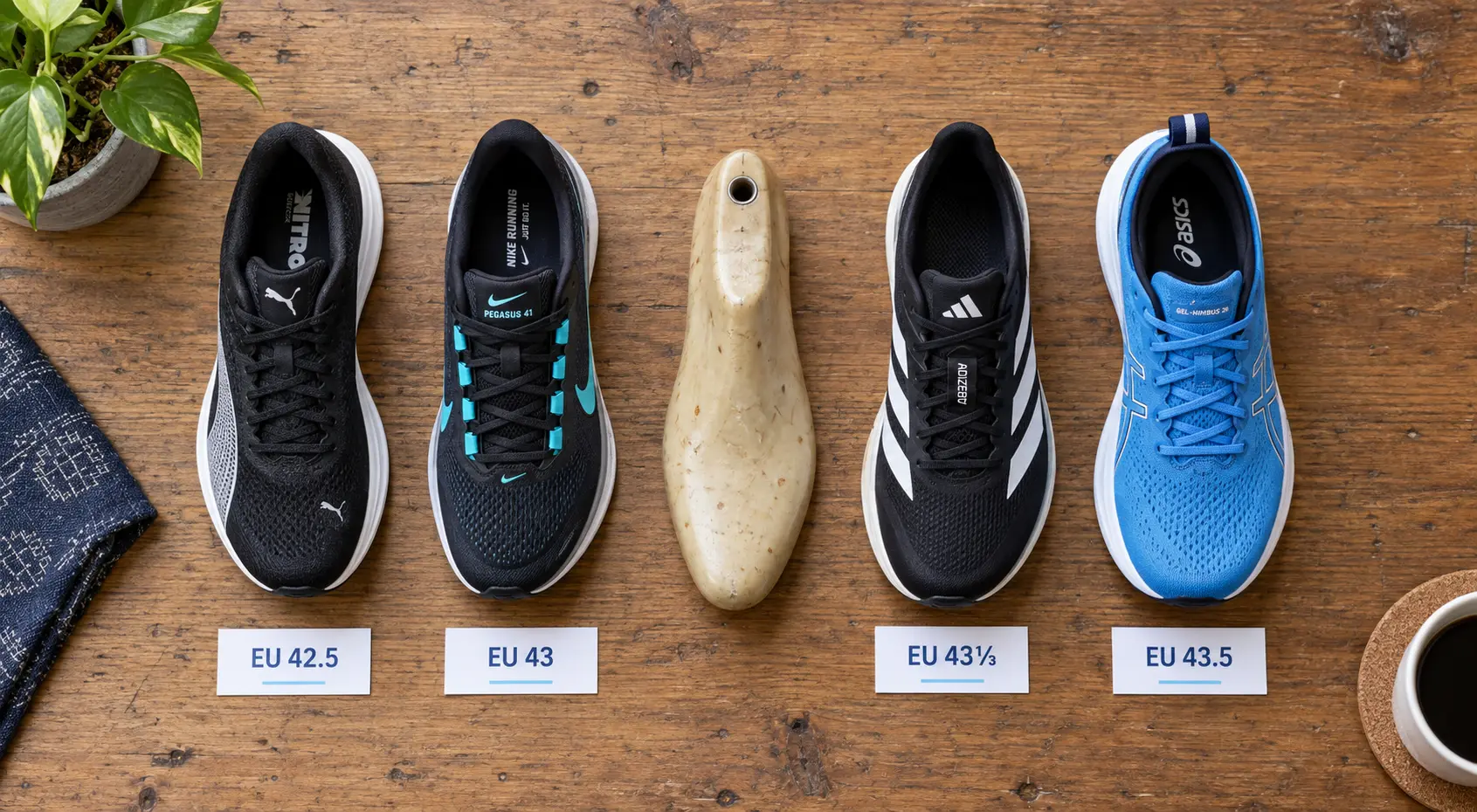

There is no such thing as your running shoe size.
Short answer
Buy the size that a shoe you already trust translates into, using both brands’ own charts. A size label is one row in one manufacturer’s table, and the tables disagree. At the foot length brands call US men’s 9.5, PUMA prints EU 42.5, Nike prints EU 43, adidas prints EU 43⅓ and ASICS prints EU 43.5. Four of the fourteen brands never print EU 43 at all. So the useful question is not what size you are, it is what size this shoe is, given a pair that already fits you. The same gap runs through women’s charts: ASICS puts EU 39 at US 7.5, where Nike, Brooks, New Balance and Saucony all put it at US 8. That is the calculation Run-It runs against 42 reviewed official charts, and it declines to answer when the evidence is missing.
Why the number on the box means so little
Shoe sizing has no enforced standard. Each manufacturer publishes its own chart mapping its own labels to its own lasts, and the sizes drift apart quietly, half a step at a time.
Run-It has transcribed and reviewed the official charts for 14 running brands, in men’s, women’s and unisex versions, which comes to 42 tables. Lining them up on one axis makes the disagreement easy to read. Take a single foot length, the one those brands each call US men’s 9.5, and look at the EU number each one prints beside it.
All 14 brands, sorted by the EU number each one prints for that single foot length. Seven agree on EU 43; the other seven do not.
| EU label printed | Brands (men’s chart) | Same as |
|---|---|---|
| EU 42.5 | PUMA, Mizuno, inov-8 | UK 8.5 |
| EU 43 | Nike, Brooks, New Balance, Saucony, On, Altra, Under Armour | UK 8.5 or 9 |
| EU 43⅓ | adidas, HOKA, Salomon | UK 9 |
| EU 43.5 | ASICS | UK 8.5 |
A full EU size of spread, for one foot. The brands also disagree about which numbers exist at all. adidas, HOKA and Salomon have no EU 43 row anywhere in their men’s chart; they step 42⅔ then 43⅓. ASICS has no EU 43 either, stepping 42.5 then 43.5. If EU 43 is your number, four of the fourteen brands do not sell it.
The same thing happens in women’s sizing, in the other direction. Nike, Brooks, New Balance and Saucony all put EU 39 at US women’s 8. ASICS puts EU 39 at US women’s 7.5. Half a size, hidden behind an identical label.
Where the generic conversion table goes wrong
Almost every size converter online, and most size pickers built into shops, works from one universal table: EU 43 is US 9.5 is UK 8.5, everywhere, always. It is a clean rule and it is the exact step that throws away the information you needed.
Run-It shipped that generic table too, in its first version. Converting every recorded size onto one shared EU-equivalent scale is a reasonable way to store data. It is a bad way to recommend a purchase, because by the time a size reaches the model it has been stripped of the one fact that mattered, which chart it came from.
We tested how much that costs. Using historical runner feedback where a person had rated two different brands as a perfect fit, we held out one brand and tried to recover its known-good size from the other. Reading both sizes through the brands’ official charts recovered 45 of 50 held-out sizes within half a step. Running the same test with the generic conversion on the source side recovered 30 of 50.
Treat that as a direction, not a score. It is 50 checks from 21 runners, every one of them a case where a perfect fit was already recorded, so it measures whether the method can find a size we know is right. It does not measure how often a recommended shoe gets returned. We have not published an accuracy figure for the product and this is not one.
How Run-It works out your size
A shoe that already fits you is better evidence than a tape measure, because it carries your foot length and how much room you personally like, which is the part no chart contains. Run-It builds on that. When you record a shoe you own, you give it a size and say how it fit. A pair you mark as a perfect fit becomes an anchor, and the sizing runs from there.
- Read the anchor from its own chart. Your Nike EU 43 is looked up in Nike’s official men’s table, not in a universal one.
- Convert onto a canonical axis. Every chart row carries a position on one shared scale, derived from the US labels published in that same chart. Foot-length and CM columns are deliberately not compared between brands, because manufacturers do not measure or round them the same way.
- Render into the target chart. That position is read back out of the target brand’s chart, for the right variant. A women’s shoe is bounded by the women’s rows and a men’s shoe by the men’s rows, because combined tables often publish a longer run for one gender than the other.
- Round to a size that exists. The result is snapped to a slot the model is genuinely made in. If the translated size falls outside that model’s real range, you get told so rather than shown the nearest number.
- Report how much evidence is behind it. Confidence is the count of separate brands confirming the anchor: one, two, or three and above. Several perfect pairs in one brand is one brand’s worth of evidence, not three.
A worked example
You own a Nike Pegasus in EU 43 and rated it a perfect fit. Nike’s official men’s chart puts EU 43 at US 9.5. ASICS’ official men’s chart puts US 9.5 at EU 43.5. So Run-It suggests ASICS EU 43.5, provided the model you are looking at is actually produced in that size. ASICS prints a different number for that length and skips EU 43 entirely. That is a fact about the chart, and says nothing about the brand running small.
A pair you rated a perfect fit, translated through both official charts.
No perfect pair yet, so this leans on one-sided fit feedback.
Your width may not be produced for this exact model.
Nothing to stand behind, so it shows no size.
One rule holds the whole thing together: a size is never adjusted by adding to an EU label. Half a size up from EU 43 means something different in every chart, and in four of them it means nothing at all. Every adjustment happens on the canonical axis and is only then translated back into a label.
When nothing you own fits perfectly
Most runners do not have a perfect pair on file. A near miss still carries information, as long as it points one way.
| How you rated the fit | Effect on the suggestion |
|---|---|
| Perfect | Used as the anchor, no shift (0) |
| Slightly small | Half a size up (+0.5) |
| Too small | A full size up (+1.0) |
| Slightly roomy | Half a size down (−0.5) |
| Too big | A full size down (−1.0) |
Those steps are applied on the canonical axis, never to the label. And they only apply when every non-perfect shoe on your profile points the same direction. If one pair was tight and another was loose, Run-It shows no size at all. Averaging a contradiction produces a number, but not an answer.
With no shoe feedback at all, the regular size on your profile is used as a last resort and flagged as such. It is a fallback, not a second anchor: record one real pair and it is dropped immediately.
Width is a separate question, and it does not move the length
Sizing up because a shoe pinches is the most common way to end up with a shoe that is too long. The foot needed room across the forefoot, and got it at the toe instead.
Run-It keeps the two apart. How a shoe fit for length and how it felt across the width are recorded as different answers, and width never shifts the length suggestion. Width feedback resolves to one of 4 width classes, narrow through extra wide, which is then checked against the width options that exact model is manufactured in.
The check is honest about what it knows. A model confirmed to be made in your width is a verified match. A model whose width options have been checked and does not include yours is filtered out of your shortlist. A model whose width data has not been verified yet is marked provisional and left in, with the availability flagged rather than assumed.
When Run-It shows you no size at all
A sizing model that always produces a number is easy to build and easy to distrust. This one fails closed, and there are five ways to hit that.
The brand’s official chart has not been transcribed and reviewed yet. The shoe’s gender variant is unknown, so there is no way to tell which rows apply. The recorded size label matches more than one row in the chart, making it ambiguous. The translated size falls outside the run that model is actually made in. Or your fit feedback points in two directions at once.
In each case the interface says the size is not available and invites you to add a shoe that fits perfectly, which is the input that would fix it. 9 brands currently sit in that state on purpose, including Topo Athletic, Karhu and Newton: their charts are queued for review, and until then Run-It will not borrow another brand’s numbers for them.
What Run-It deliberately does not do
Three things get left out, and each is a decision rather than a gap.
No fit percentage. A “94% fit match” badge would be a number invented to look like evidence. Run-It reports how many brands confirm your anchor, which is a fact about your data.
No “this brand runs small” rules. Brand-level offsets learned from aggregate feedback are held back and not applied to what you see. A chart translation can be checked against two published tables. A learned nudge cannot, and it has to earn its place first.
No hard size bans. A bad fit in one shoe does not blacklist that number everywhere. It describes that shoe’s length, not a universal label, and it downranks rather than excludes.
What V2 adds, and what has to be true first
V1 is deterministic on purpose. Every size it shows traces back to two published chart rows and one shoe you told us fit. You could redo the arithmetic by hand from the manufacturers’ own tables and get the same answer.
That is also its ceiling. Official charts describe the size run a brand prints. They say nothing about a model whose upper is cut narrow, a knit that gives after fifty kilometres, or a plated racer built on a shorter last than the rest of the line. Runners feel all three, and none of it is in a size table.
V2 is where that gets learned from outcomes rather than assumed. The blocker is measurement. Today Run-It can check whether a suggestion recovers a size you already told us was perfect, which is a much easier test than the real one. The real test is whether the shoe you actually bought fitted.
Closing that loop means recording three things instead of one: the size suggested, the size purchased, and how it turned out. With that in place, a correction can be measured against what happened rather than against another recorded opinion.
Corrections then ship only past explicit gates, set before the data comes in so the bar cannot move to fit a result. A brand-pair adjustment needs at least 10 independent runners with a confirmed perfect fit in both brands, residual spread within 0.33 of a size, and a measurable improvement over plain chart translation when tested on runners it has never seen. It also has to hold at each confidence tier separately, since a good average can hide one tier that is badly calibrated.
Until a correction clears all four, it runs in shadow: computed, logged, compared, and kept out of what you see. The one soft rule already tested this way changed six suggestions and improved none of them, which is the argument for the gates rather than against the idea.
Also on the V2 list: charts per model version rather than per brand. A brand-level table is a good approximation, and it is still an approximation of the shoe you are actually buying.
Frequently asked questions
What running shoe size do I buy?
Start from a shoe you already own that fits you perfectly, and translate that exact size using both brands' official charts rather than a generic conversion table. Size labels are not standardised: at one foot length brands print EU 42.5, 43, 43 ⅓ or 43.5, so the number on your old box only means something once you know which chart it came from.
Is EU 43 the same size in every running shoe brand?
No. In the official men's charts Run-It has reviewed, Nike, Brooks, New Balance, Saucony, On, Altra and Under Armour put EU 43 at US 9.5, while PUMA, Mizuno and inov-8 put it at US 10. adidas, HOKA and Salomon never print EU 43 at all, going 42 ⅔ then 43 ⅓, and ASICS goes 42.5 then 43.5.
Should I size up in running shoes?
Often, but the popular rule of half a size up is a substitute for information rather than a rule. It exists because runners' feet swell and need toe room, and because street shoes are usually bought a little short. Applied to a brand that already labels generously it makes the shoe too long. A known good pair is a better starting point than a blanket adjustment.
How does Run-It know my running shoe size?
From shoes you have already rated. When you record a pair and mark the fit as perfect, that becomes your anchor. Run-It reads that size from the source brand's official chart, converts it to a canonical axis, and reads it back out of the target brand's chart for the right gender variant, then rounds to a size that model is actually produced in.
What if none of my shoes fit perfectly?
Run-It can still work from a near miss if the feedback points one way. A shoe rated slightly small moves the suggestion half a size up, too small moves it a full size, slightly roomy half a size down, and too big a full size down. If your feedback points in both directions at once, Run-It shows no size instead of averaging a contradiction.
Does Run-It handle shoe width?
Width is treated as its own signal and never changes the length. Width feedback resolves to a width class of narrow, standard, wide or extra wide, which is checked against the width options the exact model is actually made in. Models that cannot be had in your width are filtered out of the shortlist.
Which brands does Run-It have official size charts for?
Fourteen: Nike, adidas, ASICS, Brooks, New Balance, Saucony, HOKA, Altra, Mizuno, On, PUMA, Salomon, inov-8 and Under Armour, each in men's, women's and unisex versions. Nine more, including Topo Athletic, Karhu and Newton, are pending review, and Run-It shows no size for them rather than borrowing another brand's numbers.
Why does Run-It sometimes show no suggested size?
Because it fails closed. If the brand chart has not been reviewed, the shoe's gender variant is unknown, the recorded label matches more than one chart row, or the translated size falls outside the range that model is made in, Run-It shows nothing rather than a number it cannot stand behind.
Will Run-It's size suggestions get better over time?
That is what V2 is for. V1 is deterministic: it translates between published charts and shows nothing when it cannot. V2 learns corrections that charts cannot express, such as a model cut narrow or built on a shorter last, but only once Run-It records the size suggested, the size bought, and how it actually fitted. Corrections ship past fixed gates: 10 independent runners confirming a brand pair, residual spread within 0.33 of a size, and a measurable gain on runners the correction has never seen. Until then they run in shadow and change nothing you see.
Can I trust an online running shoe size converter?
Only as a rough guide. Converters apply one universal table to every brand, which is exactly the step that loses the information, because manufacturers do not agree on which EU label goes with which foot length. The brand's own published chart is the better source, and the shoe's real size run is better still.
Sources
- Official manufacturer size charts, transcribed into men’s, women’s and unisex tables and reviewed by Run-It. Every comparison figure in this article is read from these tables: Nike, adidas, ASICS, Brooks, New Balance, Saucony, HOKA, Altra, Mizuno, On, PUMA, Salomon, inov-8, Under Armour. Accessed 9 September 2026. Manufacturers revise their charts, so a page may have changed since transcription.
- Run-It internal sizing pilot: 50 held-out perfect-fit target sizes from 21 runners, comparing official chart translation against generic size conversion. Pilot evidence, not a published accuracy figure.
- Run-It compared with an in-store gait analysis, including where a shop visit still wins on fit and width.
- Run-It comparison of shoe specifications against runner ratings, where the numbers on the box rank poorly as predictors.
Before your next pair
Find the running shoe you own that fits best and write down its exact brand and size. That one line is worth more than any measurement, and it is the input everything above runs on. Record it against your shoes in a Run-It shoe analysis and the size comes with the shortlist.