

The millimetre is not the risk. The switch is.
Key finding
Your shoe's heel drop barely predicts whether you will like it. How quickly you change it predicts quite a lot. In our own data, drop is one of the least informative things we look at when matching a runner to a shoe. The research points the same way. A randomised trial put 553 runners into shoes at 0mm, 6mm or 10mm and followed them for six months. Injury rates came out the same across all three. Then it found the thing that does matter. Runners who already ran regularly and were moved into a lower drop were injured more often, not less. Newer runners in the same shoes did better. There is no drop that is safer in the abstract. There is the drop your legs have adapted to, and the cost of leaving it faster than they can follow.
What we see in our own data
Run-It records a score and a would-buy-again answer every time a runner logs a shoe. That gives us something a spec sheet cannot: what runners thought after they had actually run in the thing.
Our shoe matching weighs a range of shoe characteristics against those outcomes. Heel-to-toe drop is consistently one of the least informative things we look at. It has never come close to earning the attention it gets in shops and forums.
That is a claim about how well a number predicts a runner's experience, and it is worth being precise: Run-It does not pick a shoe from its spec sheet at all. It reads how a runner actually loads a shoe, which is what the Loading Pattern Index exists to describe. Specifications are one small input to that, and drop sits at the bottom of them.
The more useful evidence is not ours anyway. It is a trial.
The argument is smaller than it sounds
Before any of the evidence, it is worth looking at what runners actually buy. Across the shoes in our data with a recorded drop, 88% sit between 6mm and 10mm. Almost half are exactly 8mm.
The 12mm shoe that half the argument is about accounts for about 3% of purchases. Zero drop is another 3%. So the great 8-versus-12 debate is being held over a number that, in practice, hardly moves. Most of the people on opposite sides of it are standing within two millimetres of each other.
That also explains something we found when we looked at individual runners. Most of them own shoes within a narrow band of drop, which looks like a strong personal preference until you notice the shelf barely offers anything else.
What the trial found
Satisfaction is one question. Injury is the better one, and it has been tested properly.
Malisoux and colleagues ran a randomised controlled trial with 553 leisure-time runners, published in the American Journal of Sports Medicine. Every runner received a cushioned shoe. The shoes were identical except for the drop, which was 0mm, 6mm or 10mm. They were followed for six months.
Overall injury rates came out the same across all three groups. Drop on its own did not make runners safer or more fragile.
The part everybody skips
That trial found one more thing, and it is the useful part.
The effect of drop depended on what the runner was already used to. Runners who ran regularly were injured more often when they were put into the lower-drop shoes, roughly two thirds more often. For runners who ran only occasionally, the lower drop went the other way and was associated with fewer injuries.
That reframes the whole argument. A regular runner has thousands of kilometres of calf, Achilles and forefoot loading built around one geometry. Drop that geometry by 6 or 10mm overnight and more of the load moves to structures that have not been asked for it before. The shoe is fine. The most likely culprit is the speed of the change, though it is worth saying that the trial did not test transition speed directly. It compared runners given different drops, and the runners with the most adaptation behind them fared worst.
“But I heel strike, so I need a high drop”
This is the version of the argument that sounds most reasonable, and it falls apart in three places.
Start with the premise. A study of 710 endurance runners asked them how they landed, then measured it. Fewer than half were right. Among the runners who actually were heel strikers, only about one in three knew it. A quarter of the group said they had no idea, and four out of five of those turned out to be heel striking. So the sentence usually begins with a self-diagnosis that is wrong more often than a coin toss.
Then the direction of cause. The belief assumes your landing picks the shoe. The biomechanics reviews suggest the influence runs at least partly the other way: more foam under the heel tends to encourage landing on it. That evidence is mixed and shows up mainly at the extremes, so we would not push it hard. It is enough to say the shoe and the strike shape each other, which makes a buying rule built on one of them a shaky thing.
Then the trial, which tested this by accident. Those 553 runners were assigned 0mm, 6mm or 10mm at random. Nobody checked how anyone landed first. If heel strikers genuinely needed a high drop, randomly dropping a pile of them into 0mm shoes for six months should have produced a mess. Injury rates came out the same across all three groups.
None of that means your landing is irrelevant to how a shoe feels. It means it is a poor reason to insist on a number, and a poorer one when most people are wrong about which category they are in. Run-It does not classify your foot strike, and we would be sceptical of anyone selling you a shoe on the strength of one. What we would pay attention to is the thing this article keeps coming back to: how far the new shoe is from the one your legs already know.
The same runner, the same drop, opposite verdicts
There is one more way to test this, and it is the cleanest one we have. Instead of comparing runners to each other, compare each runner to themselves.
Plenty of people in our data have rated several shoes. Some of those shoes they got on with. Some they did not. So we can ask a simple question of each person: were the shoes you disliked at a different drop from the shoes you liked?
If a personal ideal drop existed, the answer would be obvious. Your good shoes would sit around your number and your bad ones would sit away from it.
That is not what happens. Across the runners who had both, the shoes they disliked sat an average of less than a millimetre away from the shoes they liked, which is nothing. Ten runners disliked the higher-drop shoe, six disliked the lower one, and five had no difference at all. There is no direction to it.
The clearest version needs no statistics whatsoever. Half of these runners liked one shoe and disliked another at exactly the same drop. Same person, same feet, identical millimetres, opposite verdicts. These are not near-misses either. The liked shoe averaged 8.6 out of 10 and the disliked one 6.3, and in more than half the cases the two were three points apart or more.
All of these sit at 6mm and 8mm, which is simply where most shoes are sold, so what we can show is that those two numbers are not destiny. If the number on the box decided whether a shoe worked for you, that could not happen. Whatever separated those shoes for those runners, it was not the drop. Something else did, and fit, cushioning and how a shoe feels at your own paces are the usual candidates.
One more thing from the same data, and it cuts slightly the other way. When runners bought a shoe well away from the drop they usually buy, those shoes rated a little lower: 67% of shoes at a runner's usual drop scored above 7, against roughly 55% for shoes several millimetres away.
We are not going to call that a finding. The gap is not large enough to separate from chance, and the comparison is a little circular, since a runner's usual drop is defined by what they already chose to buy. But the direction is worth naming, because it is the same direction the trial points. Familiarity seems to be worth something. The specific number does not.
Where this could be wrong
Our own ranking measures satisfaction, not injury. Scores and repurchase intent tell you whether runners liked a shoe. They cannot tell you whether it hurt them. The injury evidence here comes from the trial, not from us.
The same-runner comparison rests on 21 people. Those are the runners in our data who both liked and disliked a shoe with a recorded drop. It is a small group, so treat the averages as directional. The part we lean on hardest, that half of them liked and disliked shoes at the identical drop, is a plain count rather than an estimate, which is why we are comfortable stating it.
We did not find that drop does nothing. We found that it is one of the least informative characteristics we look at. That is a narrower claim.
The transition argument rests on a subgroup result. The headline finding of that trial, no overall difference between drops, is its strongest result. The split between regular and occasional runners is a subgroup analysis, and subgroup results from trials are less reliable than the main comparison. It is the best evidence available on this question and we think it is the right reading, but it deserves less confidence than the headline null does.
The transition advice is a reading of the trial, not a separate finding. Malisoux and colleagues measured the subgroup difference. The practical rule of easing into a change is the standard interpretation of it.
None of this is medical advice. Where a clinician has recommended a specific drop for a specific problem, that is a real reason and this article is not the arbiter of it.
Questions runners ask
Does heel drop matter in running shoes?
Less than almost anything else on the box. In Run-It's own data, drop is one of the least informative things we look at. A randomised trial of 553 runners found no difference in injury rates between 0mm, 6mm and 10mm.
Is 8mm or 12mm drop better?
Neither, on the available evidence. No drop is better in general. The number that matters more is the gap between the shoe you run in now and the shoe you are moving to.
Should I switch to low drop running shoes?
If you already run regularly, go slowly. The trial found regular runners moved into lower-drop shoes were injured more often. For occasional runners the same trial found the opposite.
Is there an ideal heel drop for me personally?
Our data suggests not. Looking at runners who had both shoes they liked and shoes they disliked, the disliked shoes sat less than a millimetre away in drop on average, with no consistent direction. Half of those runners liked one shoe and disliked another at exactly the same drop, which is difficult to square with a personal ideal number.
How fast can I change heel drop?
There is no tested number. A sensible approach is to treat a change of more than about 4mm as a transition: keep your old pair, run part of your week in the new shoe, and build up over several weeks rather than switching outright.
I heel strike. Do I need a high drop shoe?
Probably not, and you may not be a heel striker. When 710 runners were asked how they land and then measured, fewer than half were right, and only about a third of actual heel strikers identified themselves correctly. The research also suggests a higher drop encourages heel striking rather than being required by it. In the 553-runner trial, drops were assigned at random with no one checking foot strike, and injury rates came out the same.
Why does a lower drop shoe make my calves sore?
Reducing drop shifts load toward the ankle, Achilles and calf. A runner who has built thousands of kilometres around one geometry is asking less-prepared tissue to take more work. That is why the transition matters more than the number.
What should I look at instead of drop?
Fit first, then how the shoe feels at your normal paces across repeated runs. In our own matching, several other shoe characteristics carry far more weight than drop does.
Sources
- Malisoux et al., Influence of the Heel-to-Toe Drop of Standard Cushioned Running Shoes on Injury Risk in Leisure-Time Runners. American Journal of Sports Medicine, 2016. Randomised controlled trial, 553 runners, six-month follow-up.
- Accuracy of self-reported foot strike pattern detection among endurance runners. Frontiers in Sports and Active Living, 2024. 710 runners, 42.7% self-identified correctly.
- Heel-to-toe drop of running shoes: a systematic review of its biomechanical effects. Footwear Science, 2023.
- Run-It Loading Pattern Index: how Run-It reads loading rather than picking shoes from a spec sheet.
- Run-It review of what in-store gait analysis and pronation testing can support.
- Run-It first-party shoe satisfaction records: runner ratings and repurchase answers, aggregated so each runner counts once per shoe. Accessed 3 September 2026.
Before your next pair
Next time the drop number comes up, ask a different question: how far is this from what I am running in now? That one has an answer worth acting on.
Related Articles
What is most important in running shoes?
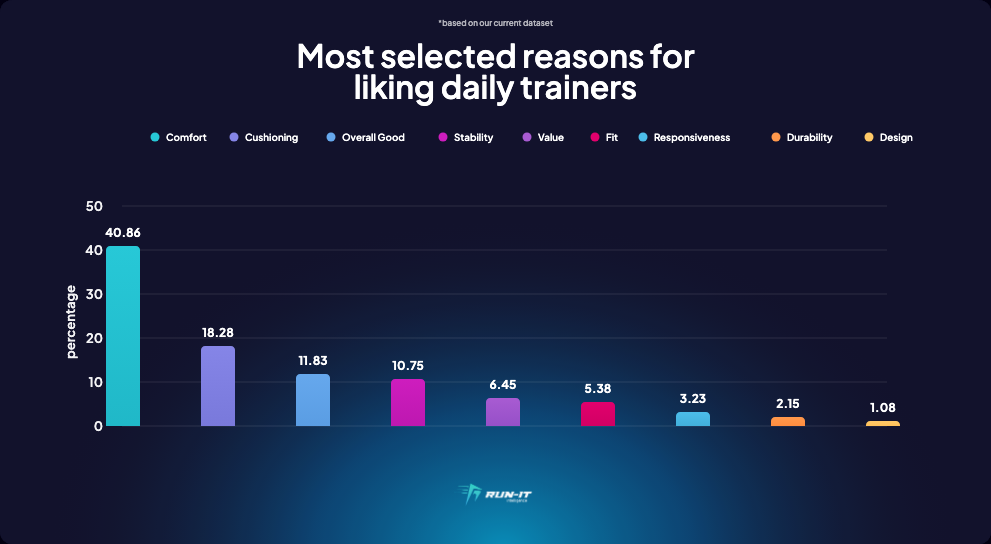
Run-It feedback shows comfort was the top selected reason runners liked daily trainers rated 7/10 or higher, at 40.86%, ahead of cushioning and stability.