
Quick answer
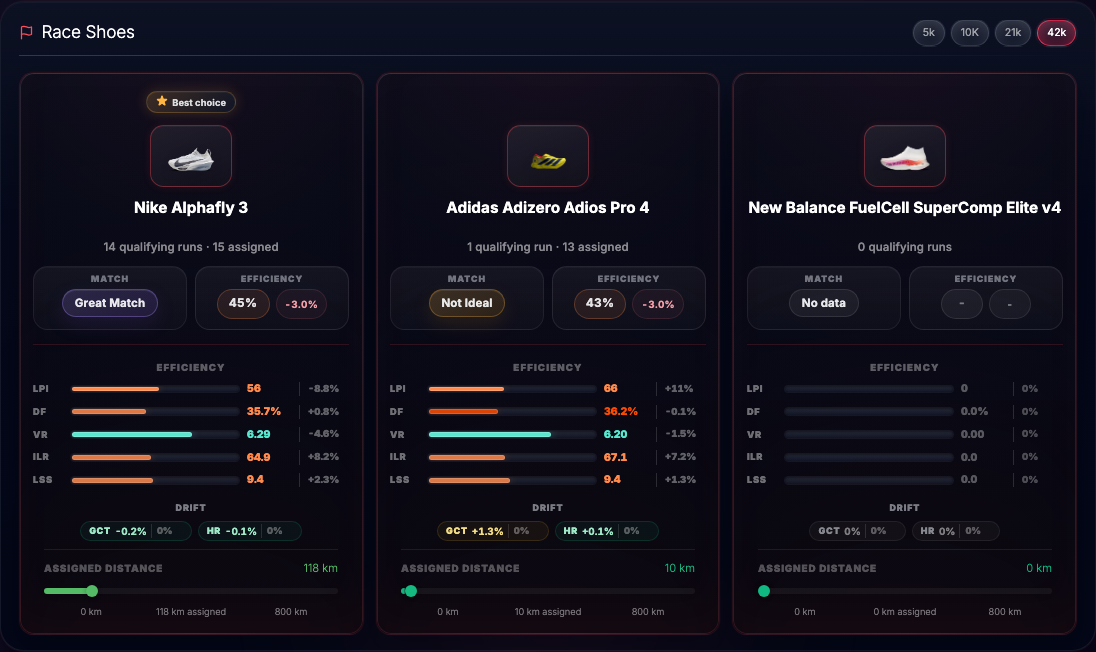
The Run-It Shoe score rates each shoe you own from 0 to 100 using your own runs in it. It compares your heart rate and your landing impact in that shoe with your usual values at the same pace, adds a small fatigue part, and weights everything for the shoe’s job: daily, tempo or race. A score of 50 means the shoe behaves like the rest of your running. Higher means a lower heart rate or a lower impact at the same pace.
Why compare shoes at the same pace
Heart rate and ground contact change with speed. A shoe you only wear for easy runs will always show a lower heart rate than your interval shoe, even if it does nothing special for you. Run-It compares each run with your own runs at the same pace, so the comparison is about the shoe, not the session.
What goes into the score
Your heart rate in the shoe at the same pace, compared with your usual value.
Your Loading Pattern Index (LPI) in the shoe at the same pace.
How much your pace-adjusted ground contact time and heart rate drift as the run goes on. Less drift scores higher.
Your usual value sits at 50, and the score stops at 0 and 100. A shoe close to 50 behaves like the rest of your running. A clear gap means the shoe changes how hard your body works, or how hard you land, at that pace.
Weighted for the shoe’s job
A daily trainer carries most of your kilometres, so impact weighs most. On race day, effort at the same pace matters most. The weights change with the job you give the shoe:
| Shoe job | Heart-rate effort | Impact | Fatigue resilience |
|---|---|---|---|
| Daily | 27% | 63% | 10% |
| Tempo | 45% | 45% | 10% |
| Race | 63% | 27% | 10% |
| Race, 5K | 75% | 20% | 5% |
| Race, 10K | 70% | 23% | 7% |
| Race, marathon | 55% | 35% | 10% |
All parts use the same runs, weighted equally.
One run to start, more runs to sharpen it
A shoe gets a score from its first run that can be compared with your other runs at a similar pace. Next to the score you will see a likely range, for example “Likely 48–53”. That range comes from how much your own heart rate varies from day to day, and it narrows as you add runs in the shoe.
A new shoe can show an early score, but treat a wide range as a first impression, not a verdict.
How sure the data is
When Run-It compares two shoes, or estimates race times from your heart rate at the same pace, it shows a Confidence percentage. It describes how sure the data is, not the chance that one shoe is faster. It drops when the result could be further off: when your daily heart rate varies a lot, when the shoes were run weeks apart while your fitness changed, or when heat, wind or the running surface differ. The race times are estimates from heart rate at the same pace, not timed races.
What the score can and cannot tell you
The Shoe score shows how a shoe behaves for you, at your paces, in your runs. It does not test the foam in a lab, it does not predict or prevent injuries, and a high score in someone else’s rotation says nothing about yours. Fit and comfort still come first: a shoe that scores well but hurts is not the right shoe.
Garmin, Stryd and Apple Watch runs give the full score. Strava runs give a lighter version, because Strava does not provide ground contact time.
How to see your Shoe scores
Connect Garmin, Stryd, Apple Watch or Strava, add the shoes you run in, and open My Shoes to see each pair’s score, its likely range and the runs behind it. For a step-by-step method of comparing pairs, read how to compare running shoes with Garmin and Stryd data.
FAQ
What is a good Shoe score?
Above 50 means a lower heart rate or a lower impact than your usual at the same pace, below 50 means higher. The score is relative to you, so compare shoes within your own rotation.
How many runs does a shoe need for a Shoe score?
One run that can be compared with your other runs at a similar pace gives a first score. The likely range next to it narrows as you add runs in the shoe.
Why did my Shoe score change?
New runs, different paces and conditions, and changes in your fitness all move it. The likely range shows how settled the score is.
Does a higher Shoe score mean a faster shoe?
Not on its own. It means a lower heart rate or impact for you at the same pace in the runs measured. Race-time estimates come with their own Confidence.