
Quick answer
A basic marathon shoe rotation usually needs three jobs covered: a comfortable daily trainer for most mileage, a tempo or workout shoe for faster sessions, and a race-day shoe that you have already tested at marathon pace. A separate long-run shoe can help, but it is optional. Add it only when your daily trainer stops feeling smooth or efficient as distance and fatigue build.
Why switching shoes can matter
Marathon training repeats a lot of similar loading: easy mileage, long runs, marathon-pace blocks, and faster workouts. If one shoe handles every run, the same foam geometry, rocker, drop, plate, upper hold, and stability pattern are repeated over and over. A rotation gives you a practical way to vary that pattern and match the shoe to the purpose of the run.
The best-known direct evidence is a 22-week prospective cohort of 264 recreational runners. Malisoux and colleagues found that runners who used more than one pair of running shoes had a lower observed risk of running-related injury than runners who mainly used one pair. That does not prove a rotation prevents injury for every runner. It does support the practical idea that varying shoe load can be useful during a long training block.
There is also a foam-recovery reason to avoid leaning on the same pair every day. A mechanical-ageing study on running shoes found that shoes given rest periods absorbed more energy when testing restarted than shoes loaded continuously, while a mileage study on heel cushioning found measurable cushioning changes as shoes accumulated distance. A rotation will not make foam new again, but it can give the midsole time to rebound between runs and avoid putting every daily impact into one compressed pair.
The second reason is simpler: one shoe is rarely best at every pace. A daily trainer can feel protective at easy pace and heavy at threshold pace. A plated race shoe can feel efficient at marathon pace and awkward during a tired recovery run. A rotation lets each shoe do the job it was bought for.
Use rotation evidence carefully
The shoe-rotation study is useful because it followed real runners during real training, but it was observational. Runners who rotate shoes may also differ in experience, training habits, strength work, recovery, or injury awareness. The safe takeaway is not "buy more shoes to avoid injury." It is: if you already run enough marathon volume to justify a rotation, assigning shoes by purpose can reduce repeated shoe-specific stress and make training decisions clearer.
The basic three-shoe marathon rotation
Start with the three core jobs. These are roles, not specific models. The right shoe is the one that fits, feels stable, and works with your mechanics at the pace and distance where you will actually use it.
| Rotation role | Use it for | What to look for | Main mistake |
|---|---|---|---|
| Daily trainer | Easy runs, recovery runs, steady mileage, warm-ups, cool-downs. | Comfort, predictable fit, enough cushioning, stable landing, durable outsole. | Buying something too aggressive for the miles you repeat most often. |
| Tempo or workout shoe | Threshold runs, intervals, strides, marathon-pace blocks, controlled faster long-run segments. | Responsive ride, secure hold, smooth turnover, not too harsh when the workout gets long. | Using a fast shoe only because it feels exciting, even if it changes your form too much. |
| Race-day shoe | Race rehearsals, key marathon-pace sessions, tune-up races, marathon day. | Efficient feel at target pace, stable cornering, no rubbing, fueling comfort, late-run control. | Saving it for race day without testing it in marathon-specific work. |
Daily trainer: the shoe that carries the plan
Your daily trainer is the boringly important pair. It should be the shoe you trust when the plan says easy, recovery, aerobic, or ordinary mileage. For most runners, this is the highest-mileage shoe in the rotation, so comfort and repeatability matter more than a dramatic ride.
A good marathon daily trainer should not make easy pace feel forced. It should keep the foot secure, feel stable when tired, and let you finish normal runs without thinking about the shoe. If it also handles some long runs well, you may not need a separate long-run shoe at all.
Tempo shoe: the bridge between training and racing
The tempo shoe is for faster work that still happens often enough to need durability and control. This can be a lightweight trainer, a plated trainer, or a firmer responsive shoe. The point is not maximum race-day speed. The point is a shoe that helps you run faster sessions without making every workout feel like a race.
For marathon training, this shoe earns its place during threshold blocks, intervals, progression runs, and marathon-pace segments inside long runs. It should feel smooth when pace changes, but it should not be so unstable or aggressive that it punishes tired mechanics.
Race-day shoe: test it before you trust it
Race-day shoes are often lighter, taller, more rockered, and sometimes plated. A systematic review and meta-analysis on footwear and running economy, plus a review of emerging sports footwear technologies, support the general idea that modern racing-shoe designs can improve economy for some runners, but the response is not identical for everyone. A fast shoe still has to work with your own stride, foot shape, cornering, and marathon pace.
Do not save an untested race shoe for marathon day. Use it in at least one controlled marathon-pace workout and one longer session segment where fueling, sock choice, fit, stability, and late-run mechanics are realistic. The goal is to remove surprises, not to wear out the pair in every workout.
Enough separation for easy mileage, faster training, and the marathon-specific shoe you will race in.
Useful when longer runs need more protection or a different fatigue pattern than your normal daily trainer gives you.
Do you need a separate long-run shoe?
Not by default. Many marathon runners can use a comfortable daily trainer for easy runs and long runs, then use the tempo shoe for faster blocks. Add a long-run shoe only when there is a real gap: your daily trainer feels flat after 90 minutes, your tempo shoe is too harsh for long marathon-pace work, or your race shoe is too expensive or aggressive for repeated long sessions.
When the fourth shoe makes sense, it usually sits between daily and race: more protective than the tempo shoe, smoother over distance than the daily trainer, and less precious than the race-day pair. It should reduce decision friction, not create overlap with shoes you already own.

How to introduce shoes without confusing the signal
Change one major variable at a time. A new plate, drop, stack height, firmness, and workout pace all at once makes it hard to know what your body is responding to.
Use each shoe where it belongs. Test daily shoes on easy mileage, tempo shoes at workout pace, and race shoes at marathon-specific pace.
Keep the first tests boring. Same route, similar surface, similar effort, and no heroic workout make the shoe response easier to interpret.
Retire overlap. If two shoes do the same job, keep the one that feels and measures better for that purpose.
How Run-It checks whether the rotation is working
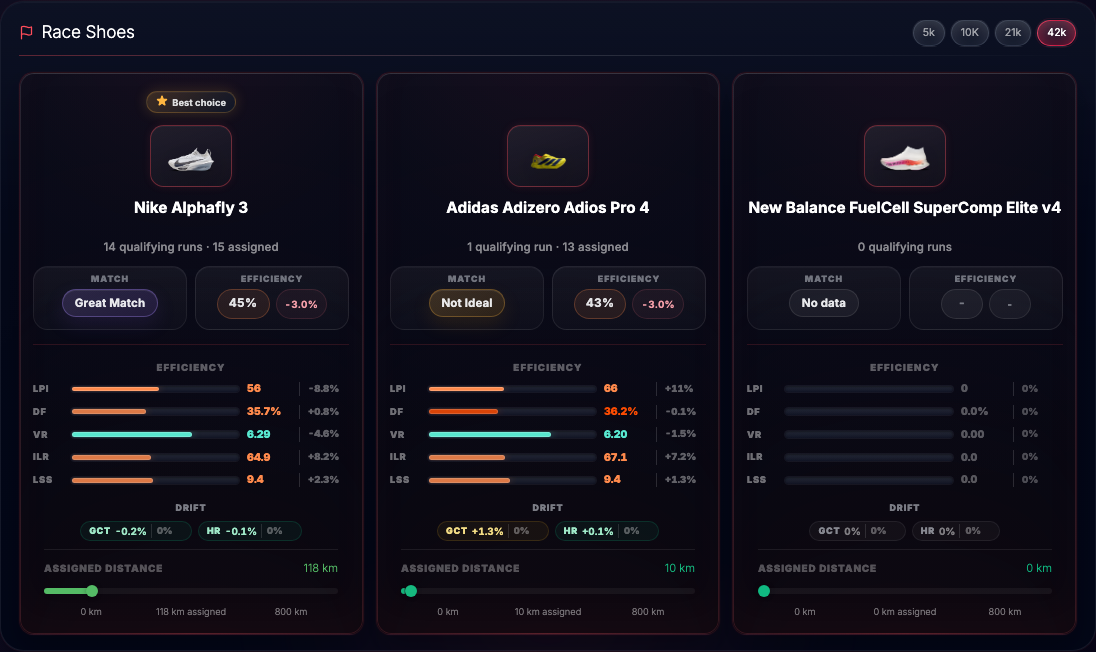
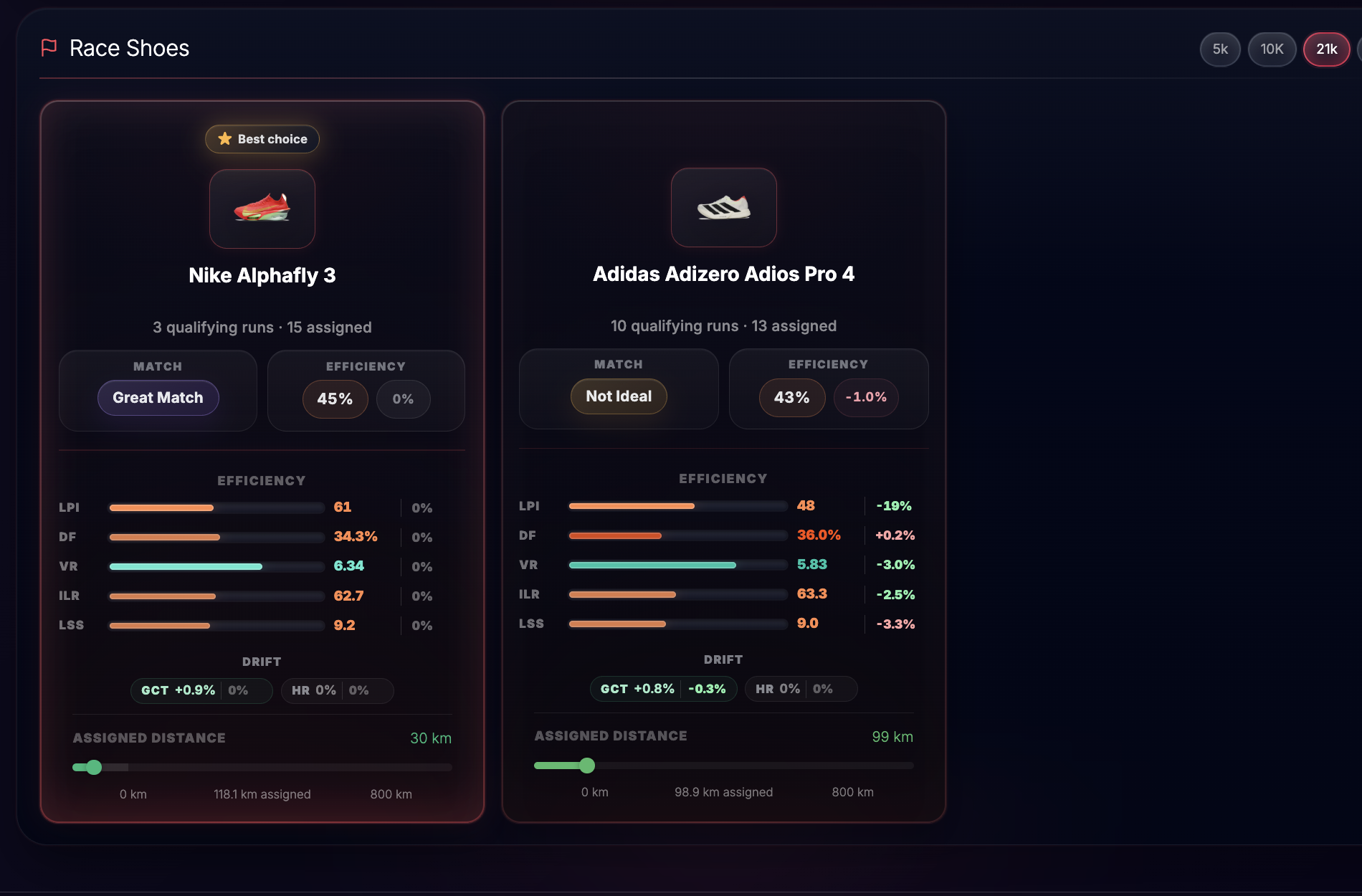
Static categories are only a starting point. Run-It looks at what happens when you actually run in the shoes. With Garmin data, the comparison can use repeated patterns in ground contact time, duty factor, vertical ratio, pace, and derived Loading Pattern Index (LPI). With Stryd data, Run-It can add more direct signals such as leg spring stiffness (LSS), impact loading rate (ILR), and duty factor.
The important part is context. A race shoe should not be judged from an easy recovery jog. A daily trainer should not lose points because it is not the fastest shoe at 5K pace. Run-It compares shoes by purpose, effort, distance, source, and confidence so the question becomes practical: which shoe looks most efficient for this runner in this role?
Our efficiency read
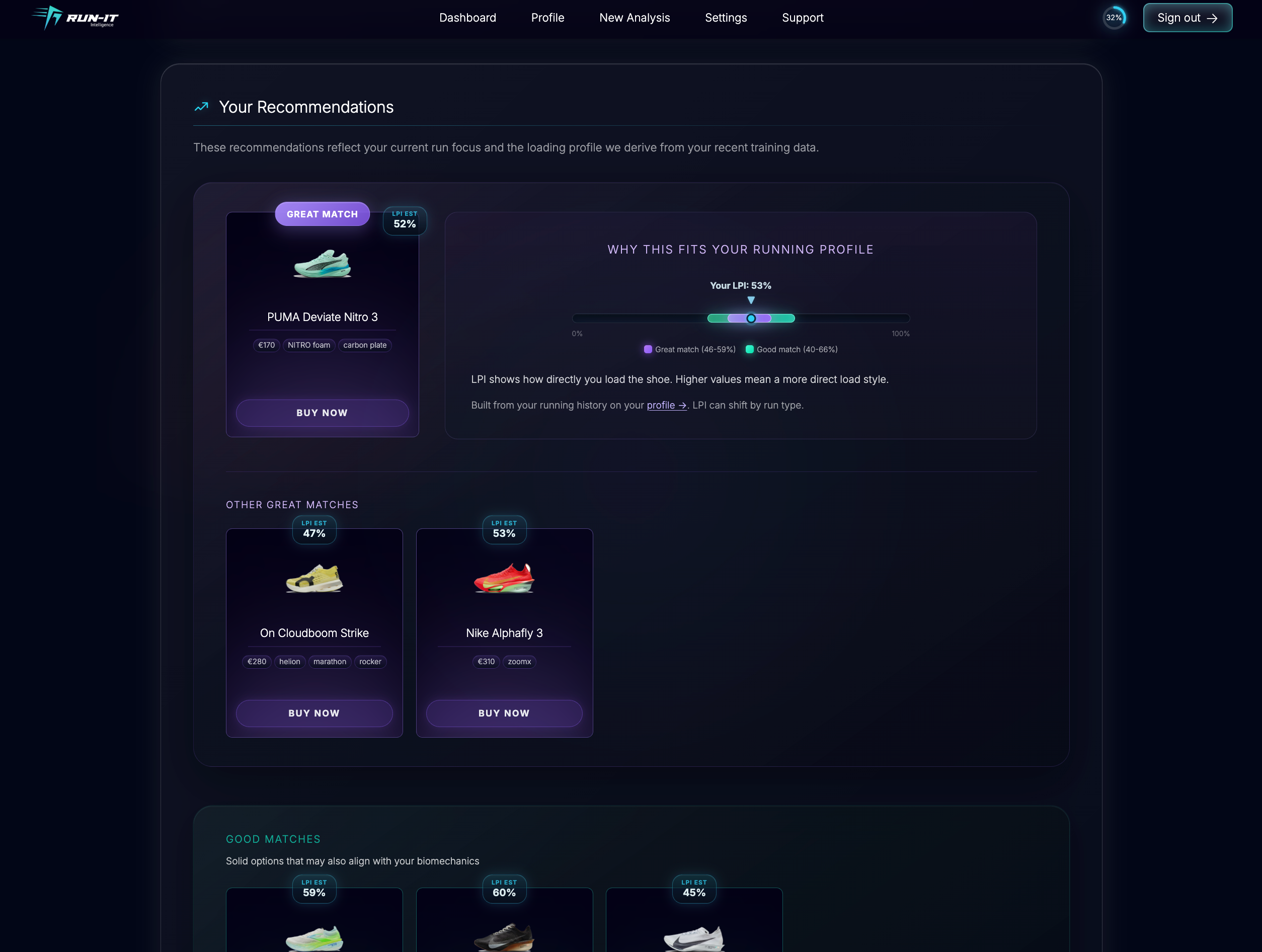
Run-It's owned-shoe comparison does not declare a universal best shoe. It reads the same runner's repeated activity context and weighs efficiency and loading differently by purpose. Daily and long-run roles care more about controlled loading and fatigue resilience. Tempo and race roles care more about efficient mechanics at faster pace while still watching load.
Fresh-window metrics give the cleaner baseline. Later-run or fatigue-window metrics show whether the shoe still behaves well when the marathon plan gets harder. That is the difference between owning three categories on paper and knowing which shoes are actually doing their job.
FAQ
What shoes do I need for a basic marathon rotation?
A basic marathon rotation usually needs a daily trainer, a tempo or workout shoe, and a tested race-day shoe. Add a separate long-run shoe only if it solves a real distance or fatigue problem.
Why should runners switch shoes during marathon training?
Switching shoes can vary repeated loading, match the shoe to the workout purpose, and give midsole foam more time to rebound between runs. A 22-week recreational runner study found lower observed injury risk among runners who used more than one pair, but that is supportive evidence, not a guarantee.
Can I train for a marathon in one shoe?
Yes, especially if the shoe is comfortable and your training is simple. But once marathon training includes higher mileage, long runs, workouts, and race-specific pacing, a small rotation often makes shoe choice clearer.
How often should I use race-day shoes before a marathon?
Use them enough to test fit, stability, fueling comfort, and marathon-pace mechanics in key sessions. Do not save an untested race-day shoe for the marathon.
Sources
- Malisoux et al. on parallel use of different running shoes and running-related injury risk.
- Allen et al. on rest periods and mechanical ageing of running shoes.
- Cornwall and McPoil on measurable heel-cushioning changes as running shoes accumulate mileage.
- Garmin Running Dynamics definitions for cadence, ground contact time, stride length, vertical oscillation, and vertical ratio.
- Stryd Metrics help article for ground contact time, duty factor, leg spring stiffness, and impact loading rate.
- Xu et al. systematic review and meta-analysis on footwear and running economy.
- Systematic review on emerging sports footwear technologies, running economy, biomechanics, and performance.
- Barnes and Kilding review on running economy measurement and physiological efficiency.