
Quick answer
Replace a running shoe when it no longer looks, holds or feels like it did, not when it reaches a fixed number. The usual signs are outsole worn through to the foam, midsole creases that stay, an upper or heel that no longer holds your foot, or the shoe feeling flat next to a newer pair. Kilometres are a reminder to check, not a deadline.
Why there is no universal lifespan
You will often see one mileage range quoted for every running shoe. It is a reasonable prompt, but it cannot be a rule, because the same shoe wears very differently depending on what it is made of, who runs in it and how.
Midsole materials age at different rates, and light race shoes are usually built for fewer kilometres than durable daily trainers.
Body weight, pace and how you land change how hard each step works the midsole.
Road, track, treadmill and trail wear the outsole and upper differently.
A pair used only for weekly intervals collects kilometres far more slowly than your daily trainer.
Cushioning does change with use. When Cornwall and McPoil followed 15 recreational runners in new shoes, heel cushioning measurably declined as the shoes accumulated distance, with clear changes by 480 km. Yet after 640 km none of the runners reported a significant drop in how cushioned the shoes felt.
The size of the effect is less settled than it sounds. A study of amateur runners in Footwear Science found that machine tests can overstate how quickly cushioning breaks down compared with real running. We are not aware of good evidence that ties a specific mileage to a higher injury risk.
Your feel is a weak alarm
Shoes change gradually, and runners in the study above did not notice a measurable change in heel cushioning. That is why a regular check, and a comparison with a fresher pair, works better than waiting until a shoe feels wrong.
Signs worth checking
Outsole worn through. When the rubber is gone in the high-wear spots and you can see midsole foam, grip and wear protection are going.
Midsole creases that stay. Deep creases along the side of the foam, especially under the heel or forefoot, suggest the foam has compressed.
A heel that leans. Put the pair on a flat table at eye level. A heel that now tilts to one side is worth noting.
An upper that no longer holds you. Torn mesh, a collapsed heel counter or a foot that slides where it used to sit still.
It feels flat next to a fresher pair. Run in a newer shoe, then go back. If the old one feels harsh or dead by comparison, that is useful information.
New aches that only show up in that pair. That is a reason to retire it. If an ache persists, see a professional. A shoe change is not a diagnosis.
So what about the mileage number?
Use kilometres as the trigger to look, not to buy. When a pair passes the distance its brand suggests, or the distance at which your previous pairs started to feel tired, run through the checks above. Some shoes will have plenty left. A light race shoe may be done sooner.
That only works if you know each pair’s distance. Most runners guess, and a guess for a shoe that shares duties with two others is usually wrong.
A rotation makes the decision easier
Running in more than one pair gives you a built-in reference: the fresher shoe shows you what the older one used to feel like. In a 22-week study of recreational runners, Malisoux and colleagues found a lower observed injury risk among runners who used more than one pair in parallel. That study was observational, so it does not prove that rotating prevents injury. Our running shoe rotation guide covers how to set one up.
How Run-It helps you decide
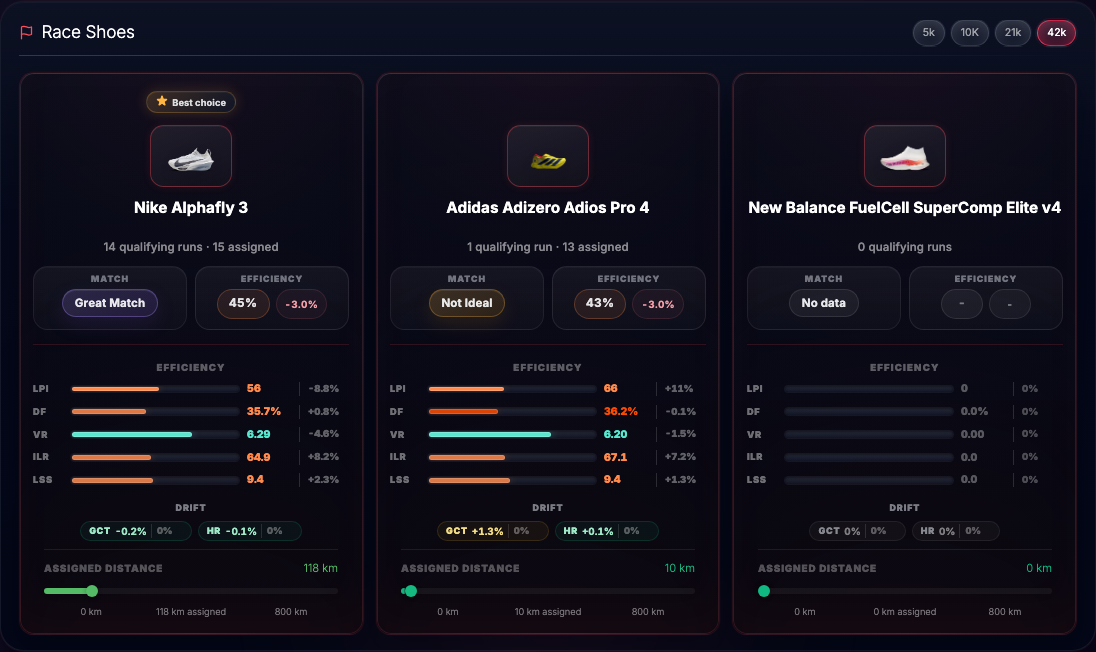
Run-It keeps a running total for each shoe, including the kilometres a pair had before you started tracking it. With Strava, it can import your gear and the distance already logged against it.
Once a pair has enough eligible run days, Run-It compares your latest run days in it with that pair’s first eight, using pace-adjusted heart rate, ground contact time, cadence and vertical oscillation. It shows whether your running in that pair has shifted. It is not a wear percentage or a replacement rule.
Mark a shoe as retired when you are done with it. It keeps your rating and stays in comparisons, but it is no longer suggested for your next run.
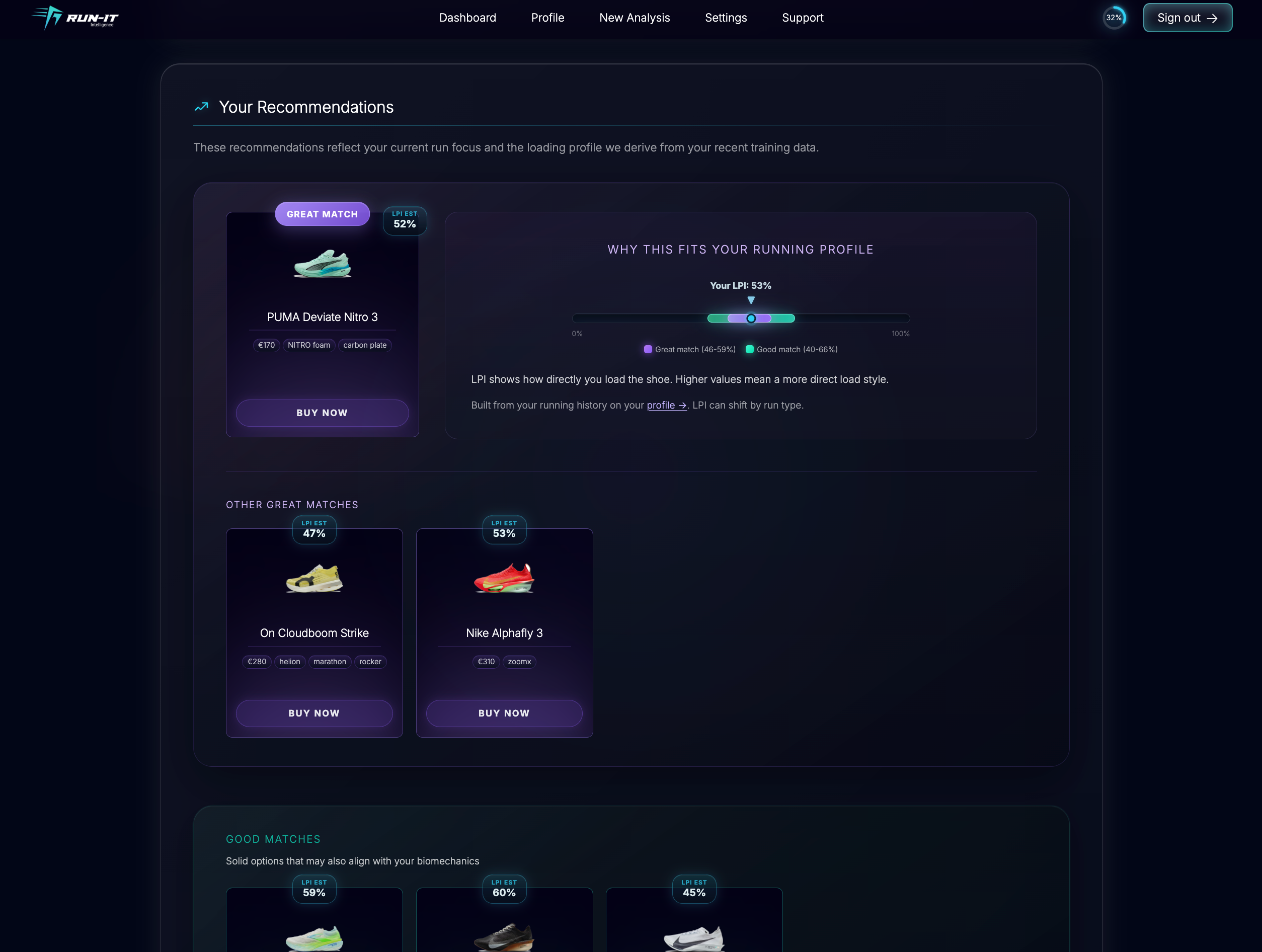
When it is time, Run-It recommends your next shoe from your own runs, not a store snapshot.
Start a free running shoe analysis to see the shoes you own side by side.
FAQ
How many kilometres do running shoes last?
It varies with the foam, the runner, the surface and the shoe’s job, so there is no single number. Treat a mileage range as a reminder to check the shoe, not as a deadline.
How do I know if my running shoes are worn out?
Look for outsole worn through to the foam, deep midsole creases that stay, a heel that leans, an upper that no longer holds your foot, or a shoe that feels flat next to a newer pair.
Can you feel when running shoe cushioning wears out?
Often not. In one study, heel cushioning measurably declined as runners covered 640 km, yet none of the 15 runners reported a significant drop in how cushioned the shoes felt.
Does rotating running shoes make them last longer?
Spreading kilometres across pairs means each one collects distance more slowly, and a second pair gives you a reference for when the first starts to feel different.
Should I replace running shoes by mileage or by feel?
Use both. Let the kilometres remind you to check, and let the physical signs and a comparison with a fresher pair make the decision.
Sources
- Cornwall and McPoil, Can runners perceive changes in heel cushioning as the shoe ages with increased mileage? International Journal of Sports Physical Therapy, 2017. 15 runners measured from new to 640 km.
- Changes in heel cushioning characteristics of running shoes with running mileage. Footwear Science, 2010.
- Malisoux et al. on parallel use of different running shoes and running-related injury risk.