
61 of 114 positive race-shoe entries. By far the most common reason. Nothing else on the list comes close.

Runners shop race shoes on grams. They keep them for the ride.
Key finding
Responsiveness is what runners like most about their race shoes, and nothing else comes close. Run-It asks one question after a good rating: what was the most important reason you liked the shoe? Across 114 positive race-shoe entries, 61 picked responsiveness. That is 53.51%, or about 1 in 2, well clear of every other option on the list. Comfort still matters at race pace, coming second at 19 of 114, about 1 in 6. The spec race shoes are sold on came near the bottom: weight was the deciding reason for 5 of 114 runners, about 1 in 23. Durability was picked by nobody. In Run-It's daily-trainer feedback the same question gets answered almost the opposite way, comfort leads there and responsiveness is rarely named. These are ratings runners chose to log, not a controlled test of any shoe.
The full reason breakdown
Every runner who rates a shoe well picks one reason from a fixed list of ten, one choice only. Here is how it broke down for race shoes.
| Reason picked | Race shoes (n=114) |
|---|---|
| Responsiveness | 61 (53.51%) |
| Comfort while running | 19 (16.67%) |
| No specific reason, overall good | 12 (10.53%) |
| Weight | 5 (4.39%) |
| Good value | 5 (4.39%) |
| Cushioning | 4 (3.51%) |
| Fit | 4 (3.51%) |
| Design or appearance | 2 (1.75%) |
| Stability | 2 (1.75%) |
| Durability | 0 |
Nothing else on the list comes close to responsiveness for race shoes. The next reason down sits more than 30 points behind it.
These are early numbers. 114 race-shoe entries is enough to see a gap this wide, and not enough to be precise about it. We are also collecting a set of one to ten scores on each shoe, for responsiveness, comfort, cushioning and the rest, which will eventually let us test this from a second direction rather than from a single forced choice. We will revise these figures as both grow.
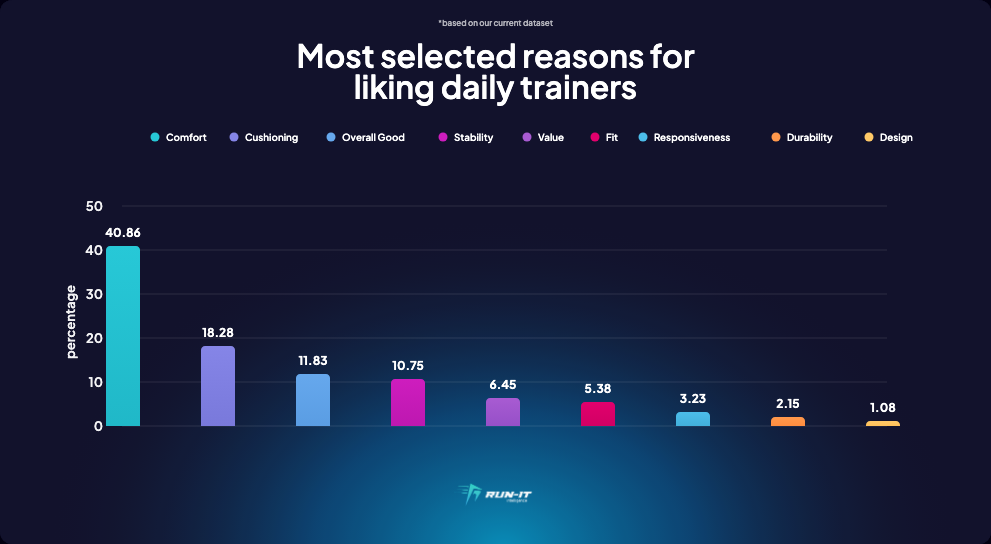
For comparison, in Run-It's daily-trainer feedback responsiveness barely registers, at around 6%, roughly an eighth of its race-shoe share. Comfort leads there instead at around 35%, with cushioning (about 18%) and stability (about 12%) close behind.
What runners mean by responsiveness
The dropdown offers the word with no definition attached, so what runners report is their own sense of it. In practice it describes a shoe giving something back at the pace they were running.
That last part is the whole mechanism, and it explains why daily trainers barely register the word at all.
A race shoe is built around a plate and a high-rebound foam that need a certain footstrike speed to do anything. Run one at easy pace and it often feels flat and slightly awkward. Run it at threshold or faster and the thing wakes up.
That pace-dependent shift is close to what Run-It's own Loading Pattern Index is built to capture: how a shoe's loading behavior changes as pace does, rather than treating a shoe as one fixed thing.
Daily trainers spend their lives at paces where that feeling never gets tested. A daily trainer is judged on the four or five hours a week it spends carrying you around at conversational pace, so what gets noticed is whether your feet hurt afterwards. Comfort at 1 in 3, cushioning at 1 in 6, stability at 1 in 7. Those are the properties of a shoe you are wearing, and responsiveness is a property of a shoe you are working with.
So the two sets of answers are really describing two kinds of run. Our earlier look at daily trainers found the same shape from the other side: when runners already like a daily trainer, they describe the value in broad comfort terms rather than in anything the midsole is doing.
More runners picked “no specific reason” than picked weight
Every race shoe launch leads with the weight. Grams shaved, the lightest plated shoe in the range, a number quoted to one decimal place in every review.
Five runners out of 114 named it. About 1 in 23, and fewer than the 12 who picked the option that reads “no specific reason, overall good shoe”.
That does not make the grams irrelevant. It makes them invisible. Weight is an input to the feeling, and the feeling is what a runner can actually report. Nobody finishes a session thinking about 34 grams. They finish thinking the shoe rolled them forward.
This is worth holding onto next time you are cross-shopping two race shoes on a spec table. The property that half of runners ended up caring about does not appear anywhere on that table, and the property that dominates the table barely registered. It is the same pattern we found when we tested every spec on the box against how runners rated the shoe, where heel-to-toe drop turned out to be one of the least informative numbers printed on it.
One in six liked their race shoe for how comfortable it was
The standard story about carbon-plated shoes is that you accept a punishing ride in exchange for speed.
The runners in this data did not report that trade. Comfort was the second most common reason they liked their race shoe, 19 of 114 entries, about 1 in 6. It is nearly four times as common as liking a race shoe for its weight.
That is a narrower claim than it might look, so it is worth being clear about what it covers. It says nothing about the runners who disliked their race shoe, because a runner who rates a shoe poorly answers a different set of questions. What it does say is that among runners who liked their race shoe, comfort being the single biggest reason turns out to be common.
If a race shoe is beating you up, this data gives you no reason to accept that as the price of the category.
How to test a race shoe for the thing that actually matters
- Judge it at race pace. The property half of runners named only shows up when the shoe is loaded fast enough to use it. A shakeout run tells you about fit and almost nothing else, which is why we compare shoes on your own recorded runs rather than on a single outing.
- Give it more than one session. The first run in a plated shoe is mostly novelty. The second and third are the ones worth listening to.
- Stop deciding between two race shoes on the weight figure. It was the single biggest reason for about 1 in 23 runners.
- Take comfort seriously. One in six runners who liked their race shoe named comfort first. Pain at race pace is information about the shoe rather than a toughness test.
- Use different criteria for the two shoes. What runners value in a race shoe barely overlaps with what they value in a daily trainer, so a single mental checklist applied to both will pick at least one of them badly.
Most runners are not choosing one shoe forever. They are building a small rotation of daily, tempo, and race shoes, and our guide to shoe rotation walks through how those roles differ in practice.
Questions runners ask
Why do runners like race shoes?
Responsiveness, more than anything else. In Run-It's first-party data, 61 of 114 runners who rated a race shoe positively picked responsiveness as the single most important reason, about 1 in 2. Comfort was second at 19 of 114, about 1 in 6.
What should I look for in a race shoe?
Responsiveness first, because that is what half of runners named as the single biggest reason they liked theirs, and it only shows up once the shoe is run at race pace. Comfort second, at about 1 in 6. Weight deserves less attention than the marketing gives it: it was the deciding reason for about 1 in 23. In practice that means judging a shoe on a workout at goal pace rather than on a spec sheet or a shakeout run.
Are race shoes comfortable?
More often than the category's reputation suggests. Comfort was the second most common reason runners gave for liking their race shoe, about 1 in 6 of them, and nearly four times as common as weight.
Does the weight of a race shoe matter?
Not as something runners notice on its own. Weight was the deciding reason for 5 of 114 runners, about 1 in 23, despite being the number every race shoe is launched on. It contributes to how responsive a shoe feels, and the feeling is what runners report.
What does responsiveness mean in a running shoe?
The sense of the shoe returning energy at the pace you are running. It depends on the pace. The same shoe that feels lively during intervals often feels flat on an easy run, because the foam and plate need a certain footstrike speed to do their work.
Why do daily trainers get rated for comfort instead?
Because of how they get used. Daily trainers cover the slow majority of a training week, where responsiveness never gets tested. In Run-It's daily-trainer feedback, comfort leads at around 35%, with cushioning and stability close behind.
Should I train in my race shoes?
This data cannot answer that, because it measures satisfaction rather than durability or injury. What it does suggest is that you will learn very little about a race shoe on an easy run, so if you want to evaluate one, do it in a session at the pace you plan to race.
Which race shoe is best?
We are not going to rank them from this data. Once each runner counts only once per shoe, just three race shoes clear even a low bar of recorded feedback, at 11 to 18 entries each. That is far too small and too self-selected to separate them fairly, and all three score well in any case.
How is this different from a shoe review?
A review is one runner's experience of one shoe, usually written soon after unboxing. This is the recorded answer of several hundred runners to the same fixed question after they had trained in the shoe, aggregated so no individual is identifiable.
Sources
- Run-It first-party shoe feedback: 114 positive race-shoe entries, one selected reason each, aggregated so each runner counts once per shoe. Accessed 8 September 2026.
- Run-It analysis of why runners like daily trainers, where comfort leads the same fixed list of reasons. The figures cited here come from a larger and more recent pull.
- Run-It comparison of shoe specifications against runner ratings, where heel-to-toe drop ranks among the least informative numbers on the box.
- Run-It Loading Pattern Index: how Run-It reads loading rather than picking shoes from a spec sheet.
Before your next race shoe
Book one workout in it at goal pace. That single session tests the thing half of runners ended up caring about, and no spec sheet will tell you the answer. If you want the same read across the shoes you already own, we can do that from your recorded runs.
Try it on your own shoesRelated Articles
What is most important in running shoes?
The same question, asked of daily trainers. Comfort led the list, ahead of cushioning and stability.
Running shoe rotation for marathon training
Where the race shoe sits alongside the daily and tempo shoes, and how to check each role with real run data.
Where do people buy running shoes?
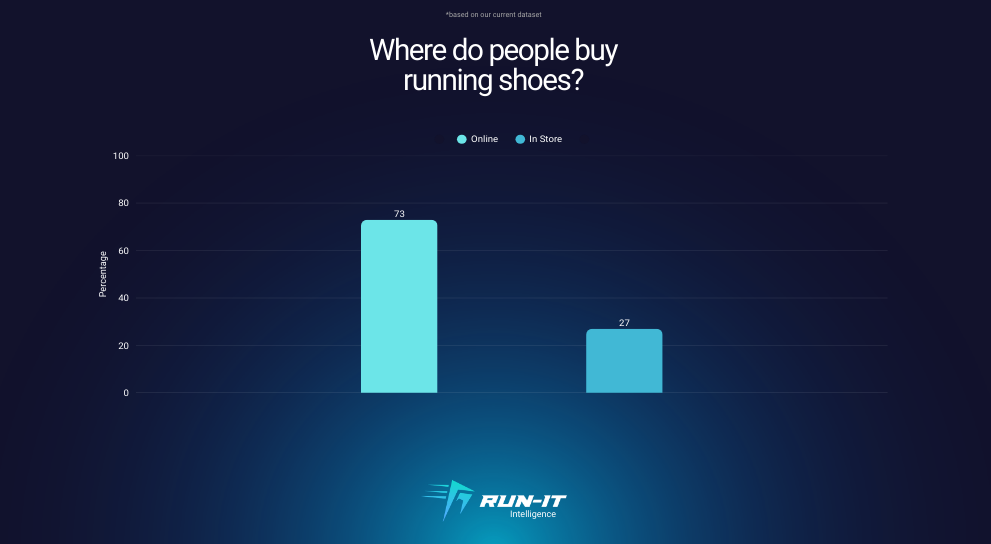
Another look at the same feedback set, this time at how runners got hold of the shoe in the first place.