
Quick answer
There is no single best running shoe finder. Quizzes are quick and need nothing from you. Retailer tools point at what a shop sells. Review catalogues compare many shoes. A store visit puts the shoe on your foot. Data tools such as Run-It use your own runs, so they only work if you already have some.
Run-It is our product
We make Run-It, and it appears in this list. We describe every tool from its own public pages, and we say where another tool is the better pick. There are no scores or rankings here, because we have not tested these tools against each other.
How we compared them
We looked at tools that help you pick a running shoe, and left out any whose own page we could not read on 9 November 2026. Each one is described against the same five points: what the pick is based on, whose shoes it covers, the cost model as stated on its page, what you need to bring and who it suits. The chart above shows the first and second points and what you need. Tap a row for more. For sites built around reviews, we go deeper in Run-It vs shoe review sites.
If you already run with a watch, you can see what your own runs suggest.
The full comparison
| Tool | Based on | Shoes covered | Cost, as stated | You need | Best for |
|---|---|---|---|---|---|
| Mizuno Shoe Finder | Quiz: surface, distance, goal, ride, stability, size | Mizuno running shoes | Not stated | Your answers | Runners set on Mizuno |
| Pace Athletic Shoe Finder | Quiz: shoe type, stride, foot type, training | The store’s curated range | Not stated | Your answers | Buying from this Australian store |
| ShoeMyRun | Quiz: surface, distance, experience, budget, priority | 60+ shoes | Free, no sign-up | Your answers | A quick shortlist with a budget |
| RunMatch AI (GearUpToFit) | Quiz, scored on nine fixed factors | 206 shoes, 18 brands | Free, no sign-up | Your answers | Seeing why a shoe scored as it did |
| Alastair Running | Quiz, scored against the reviewer’s ranked roundups | Shoes the reviewer tested | Free membership | Sign-up, your answers | Following one reviewer’s picks |
| RunRepeat catalog | Reviews, with filters | 669 running shoes | Not stated | Nothing | Comparing many shoes on paper |
| RunJudge | Reviews from 20+ publications | Shoes it has reviews for | Not stated | Nothing | Weighing value against price |
| Fleet Feet fit id | 3D foot scan and an outfitter | Outfitter’s suggestions | Free outfitting | A store visit | Trying shoes on with help |
| Run-It (our product) | Your own runs | Many brands | Free tier and Pro | Synced runs | Runners with watch data |
Brand and retailer quizzes
Mizuno’s Shoe Finder runs through seven steps, from where you run to your size.1 Its page does not explain how the answers become a pick. Best for: someone already set on Mizuno.
Pace Athletic’s Shoe Finder takes “less than a minute” and asks about your stride, foot type and training.2 Pace Athletic sells several brands from stores around Sydney and the Blue Mountains. Best for: buying from that store.
Independent quizzes
ShoeMyRun asks five questions and filters “60+ shoes” to three.3 It is free, needs no email, and says some links are affiliate links. Best for: a fast shortlist with a budget in mind.
RunMatch AI from GearUpToFit covers 206 shoes from 18 brands and publishes its factors, with terrain at 18%, and race distance and gait or support at 15% each.4 It says some links are Amazon affiliate links and that commission never changes the ranking. Best for: seeing what drove a result.
Alastair Running’s finder is “built entirely from shoes I’ve personally tested and reviewed”, and returns three picks.5 You need a free membership. Best for: anyone who trusts this reviewer’s taste.
Review catalogues and comparison tools
RunRepeat’s catalog lists 669 reviewed running shoes that you can filter by terrain, pace, brand and use.6 It says it earns commission through its links. Best for: comparing many shoes on paper. Here it is the better pick over Run-It if you want to browse the whole market.
RunJudge combines reviews from over 20 publications, estimates a fair value for each shoe and compares it with the current price.7 Best for: checking whether a shoe is good value. You can also compare two shoes in Run-It.
In a store
Fleet Feet’s fit id takes 12 measurements of your foot with a 3D scanner, and an outfitter then suggests shoes. Its page says outfitting “is always free”.8 Best for: trying shoes on with help, which no online tool can do. It answers a different question from a finder, as we explain in Run-It vs in-store gait analysis. Whichever you use, check your size with the shoe on your foot.
Where Run-It fits, and where it does not
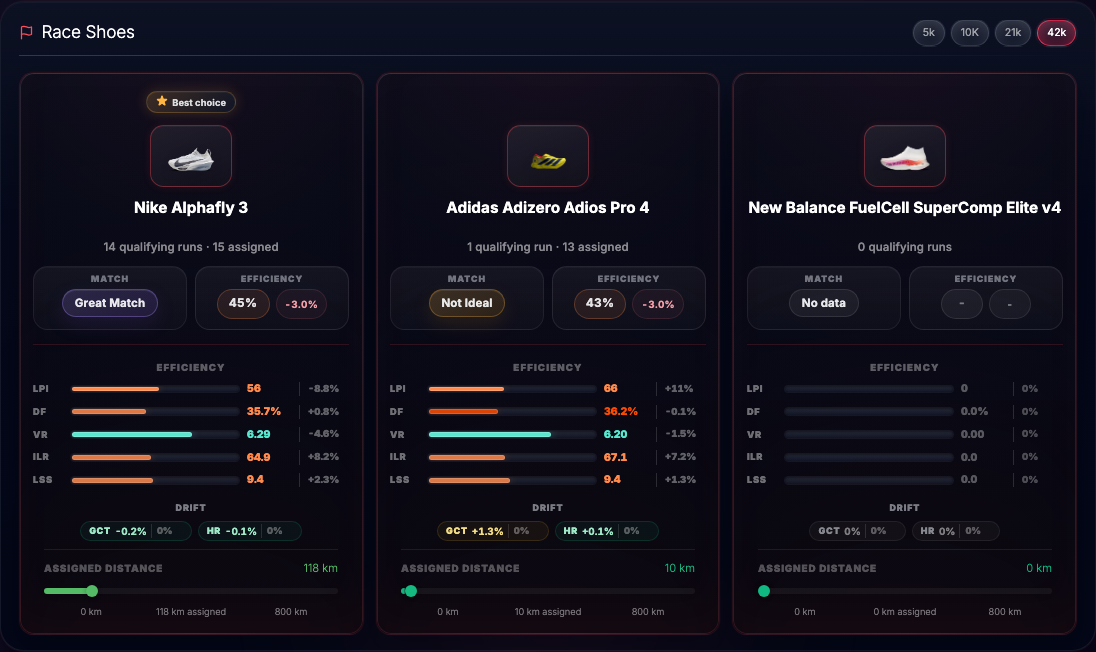
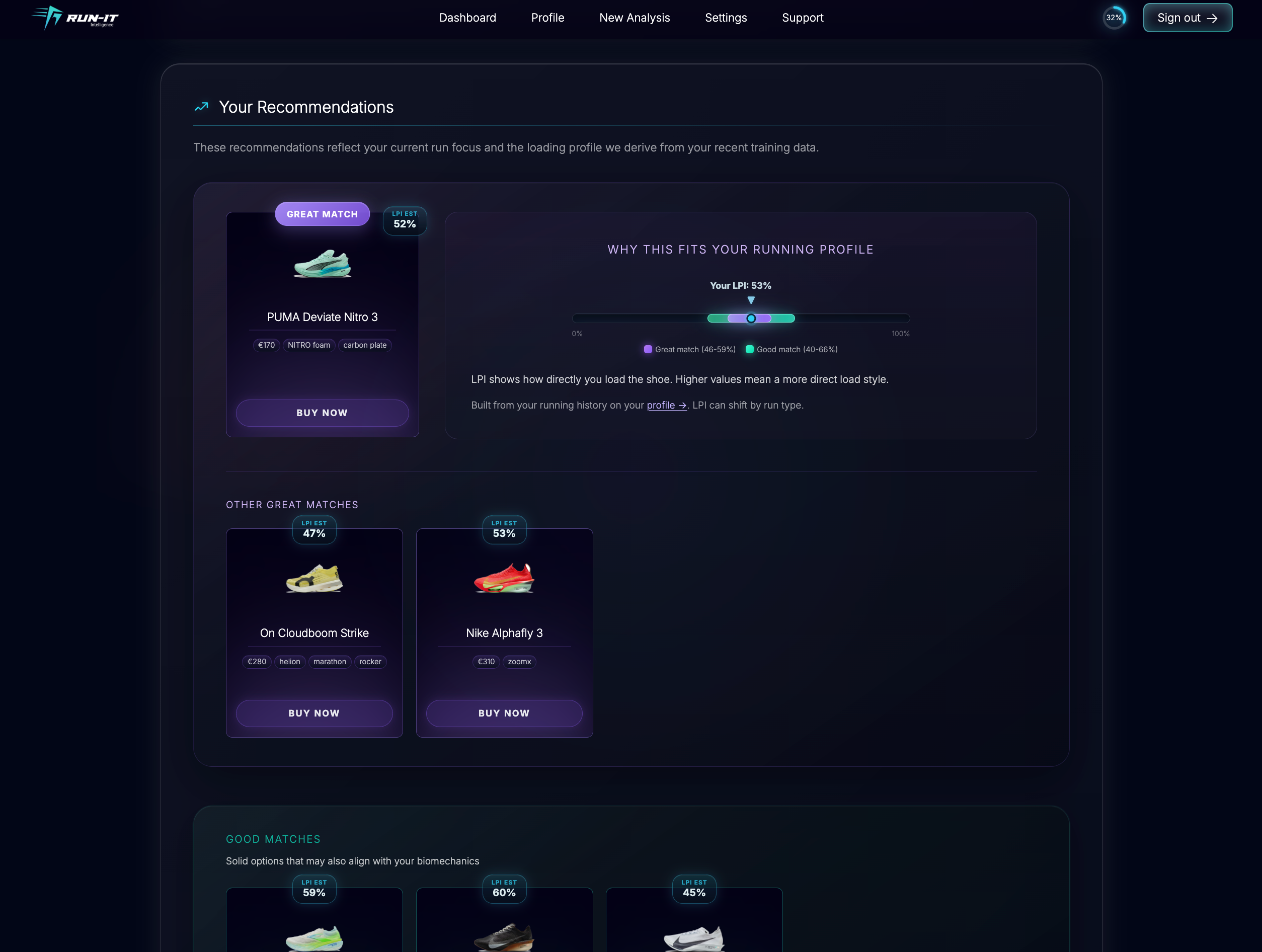
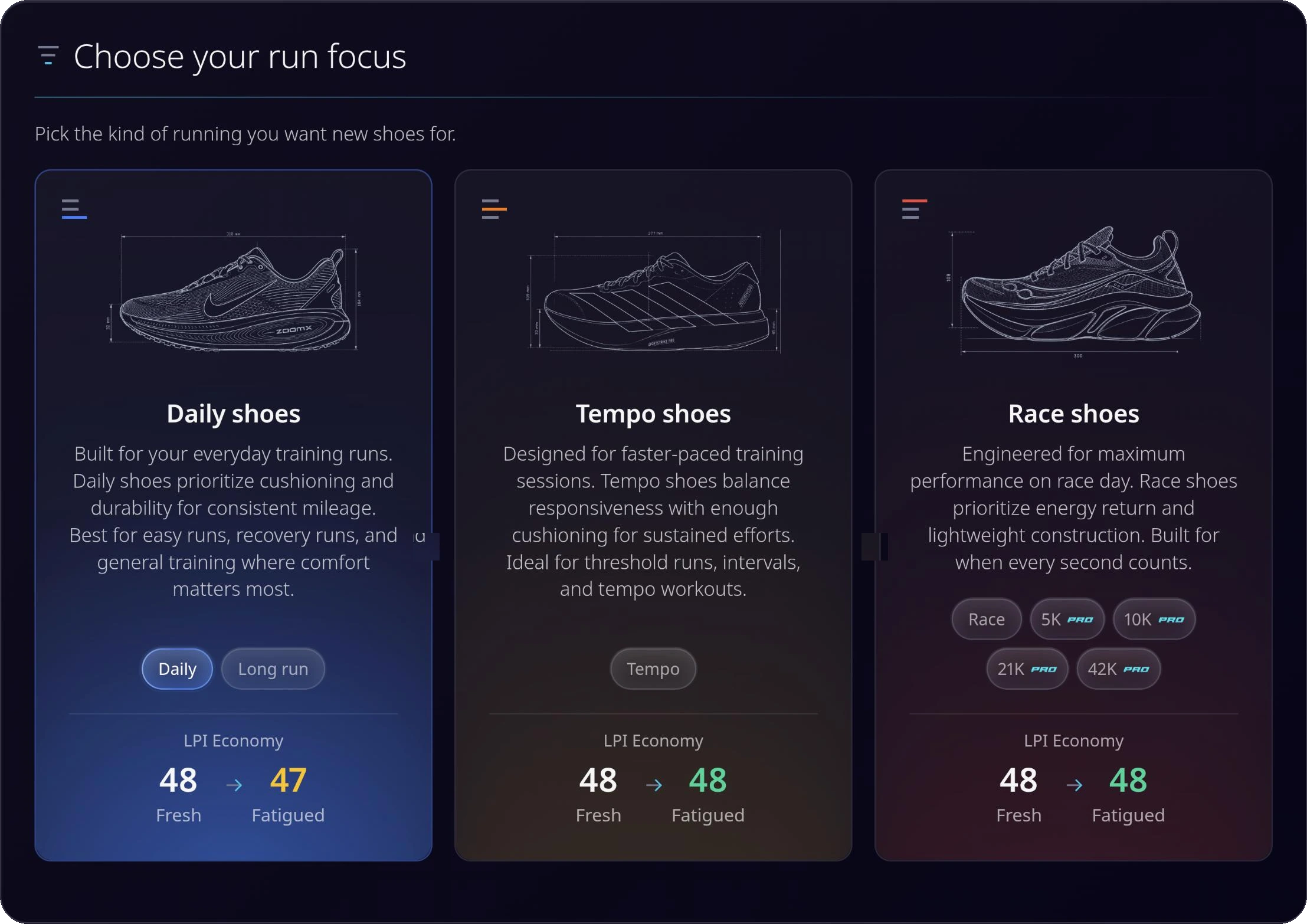
Run-It starts from your own runs on Garmin, Stryd or Strava. In the shoe analysis, your pace and weight set your load, your Loading Pattern Index breaks ties, and the shoes closest to your load come first. The page shows the top five Great and top five Good matches, and Pro’s Show all lifts that limit. A “Why this fits” panel explains each pick. For shoes you already own, the Shoe score compares them on your own runs. If you only have a file, see what a FIT file can tell you.
When another tool is the better pick
If you are a first-time runner with no watch data, Run-It has nothing to work from, so a quiz or a store is the better choice. Run-It cannot tell you how a shoe fits or feels, and it does not predict or prevent injuries. If you want to browse every model on the market, a catalogue does that better.
How to combine them
Shortlist. Use a quiz, a catalogue or your own data to get to three or four shoes. Which running shoes to buy helps with the job each pair should do.
Try them on. Fit and comfort come first, in a store or with a good returns policy.
Check with your runs. Once you own a pair, compare it with your other shoes at the same pace.
FAQ
What is the best running shoe finder?
There is no single best one. A quiz is quickest if you have no running data, a review catalogue is better for comparing many shoes, a store visit is the only one that checks the shoe on your foot, and a data tool uses how you actually run.
Are online running shoe quizzes accurate?
None of the quizzes reviewed here publishes an accuracy figure, so we cannot say. They reflect your answers, and some explain how they score them. Treat the result as a shortlist.
Can my Garmin or Stryd data recommend running shoes?
Your data can show how you run, which helps narrow a shortlist. Run-It uses it this way. It still cannot tell you whether a shoe fits, so try the shoe on.
Is a shoe finder better than in-store gait analysis?
They answer different questions. A finder narrows the options from home, and a store lets you try shoes on with help. Many runners can use both.
Do I need a watch to use Run-It?
Yes. Run-It works from your runs, so you need a synced source such as Garmin, Stryd or Strava. Without running data, a quiz or a store is the better pick.
Sources
- Mizuno. Shoe finder. Accessed 9 November 2026.
- Pace Athletic. Shoe finder. Accessed 9 November 2026.
- ShoeMyRun. Home page and quiz. Accessed 9 November 2026.
- GearUpToFit. RunMatch AI shoe finder. Accessed 9 November 2026.
- Alastair Running. Running Shoe Finder. Accessed 9 November 2026.
- RunRepeat. Running shoes catalog. Accessed 9 November 2026.
- RunJudge. Home page. Accessed 9 November 2026.
- Fleet Feet. The fit id outfitting process. Accessed 9 November 2026.