
Quick answer
Run-It reads the parts of your running form from your synced runs: landing, ground contact or leg spring, bounce, and how well you hold your form late in a run. It scores 20 drills and strength exercises against the parts with the most room to grow, and the top three become your plan. It is a general training guide, not medical advice.
Every exercise, every part of your form
The chart above is the full catalogue of the Strength page in Run-It: 20 exercises in rows, five parts of running form in columns. Three dots mean that part is what the exercise is for, two dots mean it clearly helps, and one dot means it helps a little. Tap a row to see how to do the exercise and how much. These values are Run-It’s own mapping of the catalogue. They are not research findings.
Want to know which three come out on top for you? Sign up and connect your watch.
Why one list does not fit every runner
Look down any column of the chart and you see that almost no exercise works on one part alone. Pogo hops are for ground contact and leg spring, and they help landing too. Split squats are for holding form. Which of the two deserves your fifteen minutes depends on where your own form has room to grow, and that differs from runner to runner.
Run-It already scores those parts for runners who sync a Garmin or a Stryd. How to train your running form with the Running Form Score explains the score itself. The Strength page takes the same parts and asks one more question: which exercise works on the parts where you have the most room?
The five parts the plan reads
| Part | What it is | Where it comes from |
|---|---|---|
| Controlled landing | How your foot takes the load when it lands. For Stryd runs it is called Soft landing. | Loading Pattern Index for Garmin runs, impact loading rate for Stryd runs |
| Quick ground contact | How short your foot stays on the ground for your pace. | Duty factor, Garmin runs only |
| Leg spring | How much spring your legs give back. | Leg spring stiffness, Stryd runs only |
| Low extra bounce | How little you move up and down for each step forward. | Vertical ratio |
| Holding form | How well your ground contact time holds late in a run. | The ground-contact part of the Fatigue Resilience Score |
The chart has five columns, but your plan uses four of them. A Running form score has three parts: landing, bounce, and ground contact for Garmin runs or leg spring for Stryd runs. Two of them have their own guide: what the Loading Pattern Index measures and what leg spring stiffness is and which devices record it. Holding form is added on top as the fourth part. It looks at how much your ground contact time rises late in a run, compared with the fresh part of the same run.
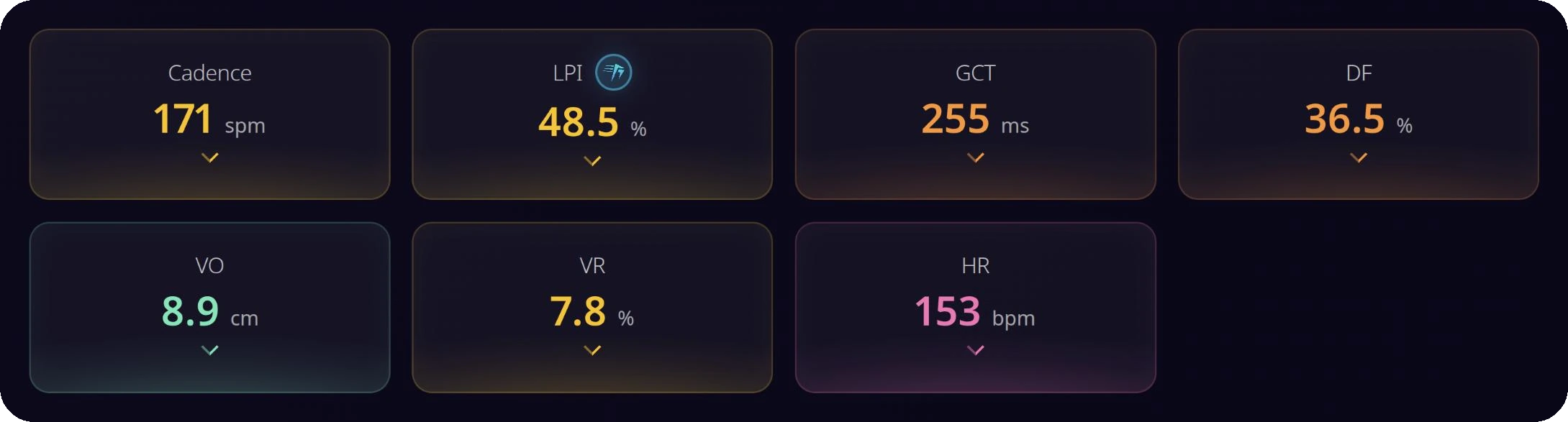
The page reads your last 90 days first. If no source has runs in that window, it looks at your whole history. Each part gets a score from 0 to 100, the same number you see on your Runs page. If you want to read those numbers one by one first, this step-by-step guide to your form data is the place to start.
How Run-It picks your three
1. Room to grow per part. Each part gets a need: its weight in your score, times the room left to 100. Room counts more than in a straight line, so a low part outranks a middling one by more than the gap between their scores.
2. Every exercise against your needs. An exercise earns the full need of a part it is for (three dots), two thirds for two dots and one third for one dot. The sum over your parts is its result.
3. The match number. The best exercise for you is set to 100 and the others are shown relative to it. The app puts it this way: “the best one is set to the top of the scale”.
4. Your plan. The three exercises with the highest match number become “Your plan: three exercises picked for you”. All 20 stay visible in the matrix under it, in order of match.
Why a low part counts for so much
Take two parts with the same weight of 30 points. One scores 40 and the other 70. Their room to 100 is 0.6 and 0.3, and raised to the power 1.5 that becomes 0.465 and 0.164. The need of the first is 30 × 0.465 = 13.9, and of the second 30 × 0.164 = 4.9. The part at 40 counts almost three times as much, although its room to 100 is only twice as large. These numbers are an example.
A part gets the amber Room to grow tag when its need is at least half of your largest need and its score is under 60. The page is careful about what that means: “That is not a verdict on your running: it is where a little strength work goes furthest.”
When every part scores 75 or higher, nothing stands out. The page then says: “Every part of your running form reads well. The plan keeps the exercises that help you hold on to it.” The match number is not a score of you or of the exercise. It only orders the catalogue for your form as it reads today, and it can change when your runs change.
Run types and race distances
Your form is scored per type of run, so the plan can be too. A filter on the page switches between all run types together, Daily, Tempo and Race. The parts and their weights differ per run type, which means your Daily plan and your Tempo plan can hold different exercises.
The plan, the parts and the full matrix for your everyday running.
The overall Race view and each distance. A distance appears once you have runs at that race effort.
Strava runs have no Running form scores, so Strava alone gives no plan.
The plan card carries a Beta tag in the app.
Garmin and Stryd do not record the same things, so the same runner sees different parts per source. How Garmin and Stryd data differ in Run-It goes through that. If you upload activity files instead of syncing, read what a FIT file needs to contain.
How often, and how to keep track
The plan card says: “Twice a week, after an easy run. About fifteen minutes for all three.” Every exercise opens to show how to do it, how much, and a video. After a session you tick what you did and save it. A calendar of the last four weeks lights up the days you trained.
The log is there for a reason. Once sessions are saved, the Insights on your Runs page can tell which sessions came before a change in your form. Your weekly recap email shows your Running form score every Monday, which is an easy place to watch it.
The app names one goal: “a lower heart rate at the same speed”, after a few weeks. That is the thing to watch for, and it is not a promise. Your form parts may move as well. The same runs also feed the Shoe score of each pair you run in.
Where the exercises come from
Fifteen of the 20 exercises come from Stryd’s running-efficiency exercises by coach Bobby McGee. Stryd groups them under five metrics, with three exercises each: cadence, duty factor, vertical oscillation, leg spring stiffness and impact loading rate. Run-It links each of those exercises to Stryd’s own write-up and video.
Run-It added five: hill sprints, jump rope, strides, heavy calf raises and split squats. In the app’s words: “We only pick and order them for you from your own running data.” If you want exercises demonstrated and corrected in person, a coach or a physiotherapist does that better than any app. The same goes for watching you run: how Run-It compares with an in-store gait analysis explains what each can see.
Start easy, stop if it hurts
“These are general exercises, not medical advice. Start with fewer reps than shown and build up. Stop if anything hurts, and with an injury or a health condition, ask a doctor or physiotherapist first.”
The plan is a way to choose among sensible exercises. It does not diagnose anything and it does not replace a training plan. New to Run-It? The Strength page builds on the same runs as the free running shoe analysis, so connecting your watch once gives you both.
FAQ
What strength exercises should runners do?
There is no single list that suits every runner. Run-It scores 20 drills and strength exercises against the parts of your own running form and puts the three that fit you best in your plan. A runner with room to grow in ground contact gets different exercises than a runner with room to grow in landing.
How often should I do the exercises?
The Strength page says twice a week, after an easy run, and about fifteen minutes for all three exercises. It also says to start with fewer reps than shown and build up.
Do I need a Garmin or a Stryd?
Yes. The plan is built from Running form scores, and those need runs from Garmin with running dynamics or from Stryd. Strava runs have no Running form scores, so Strava alone gives no plan. Ground contact is scored for Garmin runs and leg spring for Stryd runs.
Is the Strength page free?
The plan for all run types together, for Daily runs and for Tempo runs is on the free Run-It Basic plan. The Race view and the 5K, 10K, 21K and 42K distances are part of Run-It Pro.
Can I share my plan?
Yes. Share creates a link to a read-only copy of your plan. The person who opens it does not need a Run-It account.
Is this medical advice?
No. The page says so itself: these are general exercises, not medical advice and not a personal training plan. With an injury or a health condition, ask a doctor or physiotherapist first.
Sources
- Run-It Strength page: exercise catalogue, effect values and page text. Accessed 16 November 2026.
- Stryd (8 May 2025): Closer Look: Boost Your Running Efficiency With These New Exercises. Accessed 16 November 2026.
- Run-It: How to train your running form with the Running Form Score. Accessed 16 November 2026.