
Quick answer
Yes, for many runners one shoe can cover 5K to half marathon. Pick the pair that feels right on the easy runs you do most, then check it still feels good at your fastest planned race pace. You may give up a little speed in short races compared with a dedicated race shoe, and your own runs can show how the shoe holds up at each effort.
What changes between a 5K and a half marathon
The distance changes, but so does the effort. Run-It reads each race at its own heart-rate band: a 5K in Zone 5, a 10K in the upper part of Zone 4, a half marathon in the lower part of Zone 4 and a marathon in the upper part of Zone 3. Those are the bands the shoe comparison in the app uses to estimate race times. A 5K is short and as hard as you can go. A half marathon is more than four times as long at an effort you can hold for well over an hour.
That gives one shoe two jobs. At 5K effort it has to feel quick and stable at your fastest pace. Over a half it has to stay comfortable for 21.1 km. Your movement changes with pace as well: in Run-It data, the median run at 4:00 per kilometre had 224 ms of ground contact per step, against 275 ms at 6:00 per kilometre (Run-It data, 11,700 runs, pulled 17 November 2026). The same shoe meets a different stride at each speed.
Want to see your own race bands? Connect your watch to Run-It for free; the zones come from your own heart-rate settings.
What a one-shoe pick has to do
Start with the runs you do most, not the race. In Run-It data, 59% of runs are logged as daily runs, 23% as tempo runs and 18% as interval runs (Run-It data, 11,700 runs, pulled 17 November 2026). Most of the kilometres a single pair carries are easy kilometres. That is why the advice on which running shoes to buy first starts with a daily trainer, not a race shoe.
1. Comfortable on your most common run. If it is not comfortable on an ordinary easy run, it will not become comfortable at kilometre 18 of a half. Runners who rated a daily trainer highly named comfort most often; what makes a running shoe comfortable has the full list.
2. Still fine at your fastest race pace. Run a few strides or a short tempo section at 5K pace in it. A shoe that feels loose, unstable or sluggish there will feel the same on race day.
3. Comfortable late in your long runs. The half marathon test is not the first kilometre but the last ones. Check how the shoe feels at the end of your longest training runs.
4. A fit that works for an hour or more. Feet swell over longer runs, so leave room in the toe box. Choosing the right running shoe size explains how much.
Specs like stack height or drop matter less than how the shoe feels on you. If you want to understand one of them, what heel drop in running shoes means is a good start, but a shoe with the “right” numbers that you do not enjoy running in is the wrong shoe.
What you give up with one shoe
The trade-off sits mostly at the short, fast end. Race shoes are built for your hardest efforts. In a lab study by Hoogkamer and colleagues, 18 high-calibre runners used about 4% less energy on average at 14 to 18 km/h (about 4:17 to 3:20 per kilometre) in a carbon-plated prototype racing shoe than in two established racing shoes. Every runner in that study used less energy in the prototype. That is a comparison between racing shoes, at speeds faster than most 5K to half marathon runners race, so it does not tell you how many seconds a race shoe would save you.
Runners notice the difference too. Among runners who rated a race shoe at least 7 out of 10, responsiveness was the most common reason they liked it, picked by 53.51% (61 of 114); why runners like their race shoes has the full breakdown. Comfort is what runners credit their daily trainers with. One pair asks you to choose which of the two matters more to you.
One shoe is a choice, not a mistake
A versatile daily trainer gives up some speed in a 5K and gains comfort in every easy run and in the second half of a half marathon. If you race a few times a year for the experience, that trade is often worth it. If you chase seconds in short races, a second pair may earn its place.
When a second pair earns its place
A second pair makes sense when you race often and care about time, when your long easy runs would feel better in a softer shoe, or when one pair wears out quickly because it carries every kilometre. If that is you, building a running shoe rotation from your data shows how runners split daily, tempo and race shoes. One pair is a fine place to start.
Whichever you choose, a single pair carrying all your running will reach its limit sooner than two pairs sharing the work. There is no fixed number of kilometres; when to replace your running shoes covers what to watch for.
Check your one pair with your own runs
Run-It reads your runs from Garmin, Stryd, Apple Health or Strava and scores each shoe. On My Shoes, Best shoes by type ranks your shoes for daily, tempo and race runs, compared at similar paces. In the account below, the same pair leads all three types: one shoe that covers everything that runner does.
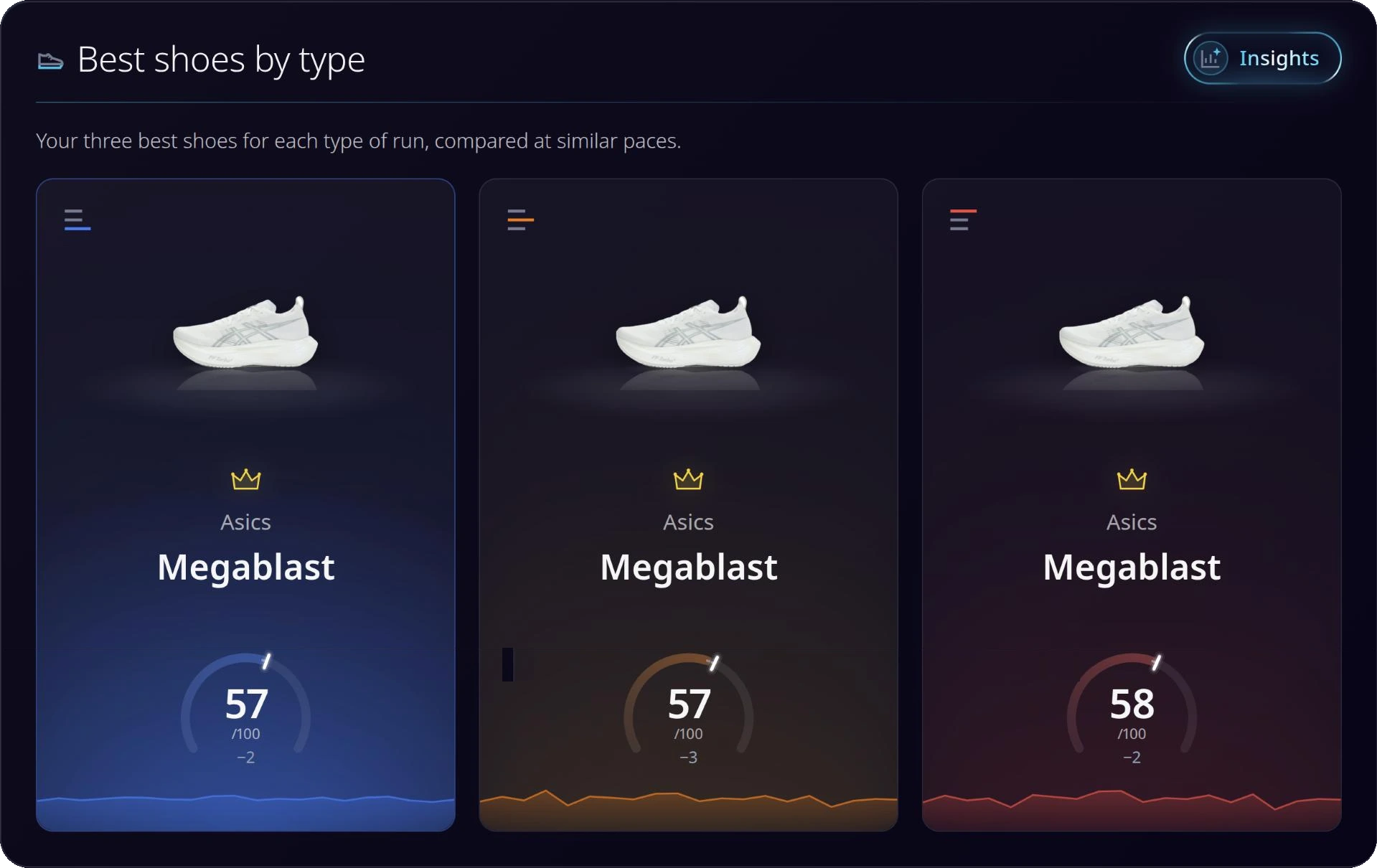
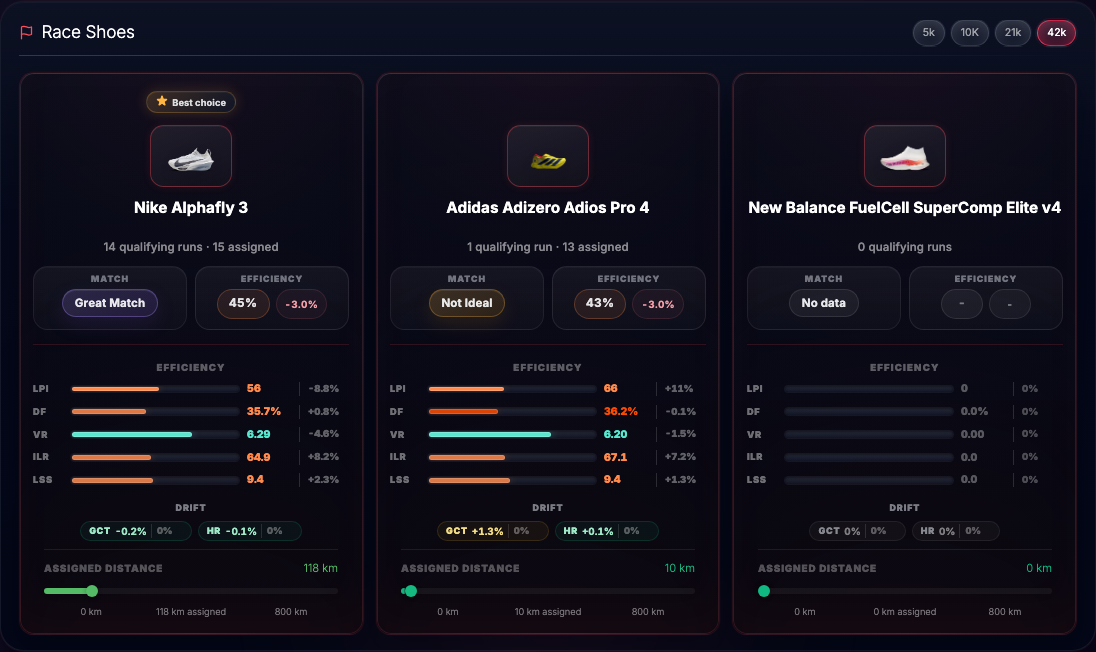
How the Run-It Shoe score works explains what that number reads. Once you own two pairs, the comparison card on My Shoes goes further: it compares the two at the same heart rate and shows what the gap is worth over 5K, 10K, 21K and 42K, each at its own effort, for example “your 5K would be 10 seconds faster”. A race with fewer than 3 runs at its effort in a shoe gets a star, because the estimate then falls back on all runs. You can also compare running shoes side by side before you buy.
Not sure which pair to make your one shoe? The free running shoe analysis matches shoes to your pace, weight and running data, and your easy vs hard split shows how much of your week your shoe spends at easy effort.
Is one pair enough to race a half marathon?
It can be. If you have done your long runs in it and it still feels comfortable at your goal pace late in those runs, it is a reasonable shoe to race a half marathon in.
Should my one shoe be a daily trainer or a race shoe?
Usually a daily trainer, because most of your kilometres are easy runs. A light, versatile daily trainer covers the most ground. A race shoe is built for your fastest efforts and is rarely the most comfortable choice for every easy run.
Will I be slower racing in a daily trainer?
Possibly a little. In a lab study, 18 fast runners used about 4% less energy on average in a carbon-plated prototype than in two established racing shoes. That is a race-shoe comparison at fast speeds, not a promise for your own race.
How do I know if my shoe is holding me back?
You need a second pair to compare against. On My Shoes, Run-It compares two shoes at the same heart rate and shows what that is worth over 5K, 10K, 21K and 42K. A race with fewer than 3 runs at its effort in a shoe gets a star, because it falls back on all runs.
When should I add a second pair?
When you race often and care about seconds, when you want a softer shoe for long easy runs, or when one pair is wearing out quickly because it carries all your kilometres.
How long will one pair last if I use it for everything?
There is no fixed number of kilometres. One pair that carries every run reaches its limit sooner than two pairs that share the work. Watch how the shoe feels and how your data changes.
Sources
- Hoogkamer W, Kipp S, Frank JH, Farina EM, Luo G, Kram R. A comparison of the energetic cost of running in marathon racing shoes. Sports Medicine, 2018;48(4):1009-1019. Accessed 20 November 2026.
- Correction to: A comparison of the energetic cost of running in marathon racing shoes. Sports Medicine. Accessed 20 November 2026.
- Run-It My Shoes: Best shoes by type and the shoe comparison card with race times at the same heart rate. Accessed 20 November 2026.
- Run-It. Why runners like their race shoes: feedback from runners who rated a race shoe at least 7/10. Accessed 20 November 2026.